Campus recruitment trends 2026 for universities and TPOs
Blogs

The Future of Campus Recruitment: 8 Trends Every TPO Should Know in 2026

The Role of Placements Has Changed For the longest time, institutions were judged largely on their graduation rates. Today, the conversation has shifted. Students and parents are no longer asking, “How prestigious is this university?” Instead, they’re asking: Placements have become one of the biggest deciding factors while choosing an institution because they represent the return on a student’s investment in higher education.This growing focus on outcomes reflects broader concerns around Graduate Employability in India. Understanding the latest campus recruitment trends in 2026 is becoming essential for institutions that want to improve student employability and placement outcomes. This shift has also changed the role of Training and Placement Officers (TPOs). Campus recruitment is no longer just about inviting companies for placement drives; it’s about preparing students to become employable long before recruiters step onto campus. Recruitment itself is evolving at an unprecedented pace. AI is changing hiring processes, companies are moving towards skills-based recruitment, and employers expect graduates to contribute from day one. Let’s look at the biggest trends every TPO should be prepared for in 2026. 1. Skills Are Becoming More Important Than Degrees A degree opens the door, but skills help students walk through it. While academic performance continues to matter, employers increasingly evaluate candidates based on what they can actually do rather than what they have studied. An impressive CGPA alone is no longer enough to secure a competitive role. Recruiters are looking for students who can solve problems, communicate effectively, adapt quickly, and apply their knowledge in real-world situations. According to the World Economic Forum’s Future of Jobs Report, analytical thinking remains one of the most in-demand workplace skills, while AI literacy is becoming increasingly valuable across industries. Some of the most sought-after skills in 2026 include: Many universities are already moving beyond traditional classroom learning by partnering with companies for live projects, hackathons, internships, and industry collaborations. These experiences expose students to real business problems, helping them develop practical skills alongside academic knowledge. As AI continues to automate repetitive tasks, companies are increasingly looking for graduates who can think critically, solve complex problems, and work effectively with technology, not compete against it. 2. AI Is Reshaping Campus Hiring The recruitment process itself has changed drastically. Today, many companies use AI even before a recruiter looks at a candidate’s profile. AI is helping organisations: This means students are no longer preparing only for human interviews, but they are also preparing for AI-driven hiring processes as well. For TPOs, this creates a new responsibility: helping students understand how modern recruitment works so they are not caught off guard during placement season. 3. Recruiters Want Job-Ready Graduates, Not Just Qualified Graduates One of the biggest expectations employers have today is simple: “We want graduates who can contribute.” Organisations invest significant time and money in hiring talent. Naturally, they prefer candidates who require minimal onboarding and can quickly adapt to workplace expectations. Being job-ready goes beyond technical expertise. It includes: Many candidates lose opportunities not because they lack knowledge but because they struggle to communicate it effectively. This is why employability skills are becoming just as important as technical skills. 4. Placement Preparation Needs to Start Earlier One of the biggest mistakes institutions make is beginning placement preparation only a few months before campus recruitment begins. Unfortunately, confidence cannot be built overnight, nor can communication skills. Nor interview readiness. Preparing students for placements is a continuous process that should ideally begin from the second year itself. Students need time to: Mock interviews play a particularly important role because they simulate real hiring scenarios in a safe environment. Students receive constructive feedback, identify their weaknesses, and improve before facing actual recruiters. The more students practise, the more confident they become. 5. Personalised Career Guidance Is Becoming Essential No two students have the same career aspirations. One student may dream of becoming a Data Analyst, while another wants to build a career in Product Management or Marketing. Yet many institutions continue to provide the same guidance to everyone. Personalised career guidance helps students: When students have clarity about where they want to go, they make better decisions about internships, certifications, projects, and placement preparation. Career clarity ultimately translates into greater confidence during placements. 6. Data-Driven Placement Decisions Will Define Successful Institutions The future of placements isn’t just digital, it’s data-driven. Imagine knowing: Many institutions are now adopting frameworks like the Job Readiness Index (JRI) to measure student readiness before placement season, enabling earlier interventions and more informed placement decisions. Instead of relying on assumptions, TPOs can make informed decisions backed by real insights. This allows institutions to intervene early, design targeted training programmes, and improve placement outcomes across the entire campus. 7. Soft Skills Will Continue to Be a Competitive Advantage Technical knowledge may get students shortlisted, but soft skills often determine whether they receive the offer. Recruiters consistently value graduates who can: These skills become even more important as AI automates technical and repetitive tasks. The graduates who stand out will be those who combine technical expertise with strong interpersonal skills. 8. Placement Success Is Becoming Employability Success Perhaps the biggest shift in campus recruitment is this: Institutions are no longer measured by how many placement drives they organise. They are measured by how employable their students are. Successful institutions are moving from reactive placement preparation to continuous employability development. Instead of preparing students only during the placement season, they are helping them improve throughout their academic journey through assessments, industry exposure, resume building, interview practice, and personalised guidance. That shift is defining the future of campus recruitment. How 7Seers Helps Institutions Stay Ahead The future of placements isn’t about working harder; it’s about preparing smarter. At 7Seers, we help institutions move beyond traditional placement preparation by enabling continuous employability development throughout the student journey. From AI-powered mock interviews, resume building, and skill-gap analysis to role-based assessments, career insights, and placement analytics, 7Seers empowers TPOs with the tools they need to prepare students proactively rather than reactively. Better placements
skill-to-job-mapping-placement-readiness.
Blogs

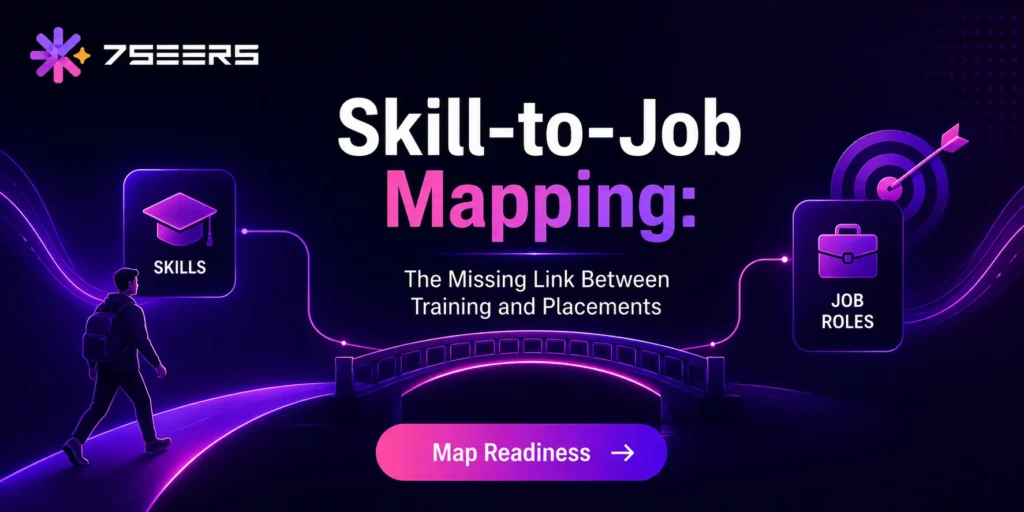
Skill-to-Job Mapping: The Missing Link Between Training and Placements 

Every year, colleges invest significant time and resources into aptitude training, coding programs, communication workshops, and certification courses.  Students attend the sessions.  Training reports show completion rates.  Yet when placement season begins, a familiar question emerges:  The answer often lies in skill-to-job mapping, which helps institutions understand whether training efforts are actually translating into job readiness. Who is actually ready for the jobs recruiters are offering?  This gap exists because most institutions measure training participation, not job readiness.  The solution lies in Skill-to-Job Mapping.  Institutions are increasingly complementing this approach with frameworks such as the Job Readiness Index (JRI) to measure overall readiness. What is Skill-to-Job Mapping?  Skill-to-Job Mapping is the process of connecting the skills students possess with the skills required for specific job roles.  Instead of asking:  “Did students complete the training?”  Institutions can ask:  “Are students ready for the roles they want to apply for?”  This shifts the focus from activity tracking to employability outcomes. Increasingly, job readiness is becoming the new metric of institutional success for colleges and universities. The Problem with Traditional Training Models  Most colleges operate with a one-size-fits-all approach:  The result?  By the time these gaps become visible, corrective action is often too late.  How Skill-to-Job Mapping Changes the Game  Imagine a student targeting a Software Development role.  Instead of simply completing training modules, the student can see:  Now multiply this visibility across an entire graduating batch.  Placement teams can instantly identify:  Benefits for Placement Teams  1. Better Placement Forecasting  Know how many students are genuinely prepared for specific roles before placement drives begin.  2. Targeted Interventions  Instead of training everyone the same way, focus efforts where skill gaps actually exist.  3. Recruiter Confidence  Present recruiter-ready talent pools backed by measurable readiness indicators.  4. Data-Driven Decision Making  Move beyond attendance reports and evaluate training effectiveness through readiness outcomes.  Modern placement strategies increasingly rely on employability analytics rather than participation metrics. 5. Improved Student Outcomes  Students gain clarity on what employers expect and what they need to improve.  From Skills to Employability  The future of placements is not about conducting more training sessions.  It’s about understanding whether training translates into employable skills.  This shift from training activity to workforce readiness is changing how institutions approach placements. Colleges that can continuously map skills to job roles gain a significant advantage:  The Way Forward  In today’s job market, employers hire for specific competencies—not just degrees.  Institutions need visibility into how student skills align with industry expectations.  Skill-to-Job Mapping bridges the gap between learning and employment, helping colleges answer the questions that matter most:  Because successful placements start long before the recruiter arrives.  About 7Seers  7Seers helps institutions measure job readiness, identify skill gaps, and map students to career opportunities through AI-powered assessments and readiness insights—enabling colleges to make placement decisions with confidence. 

Blogs

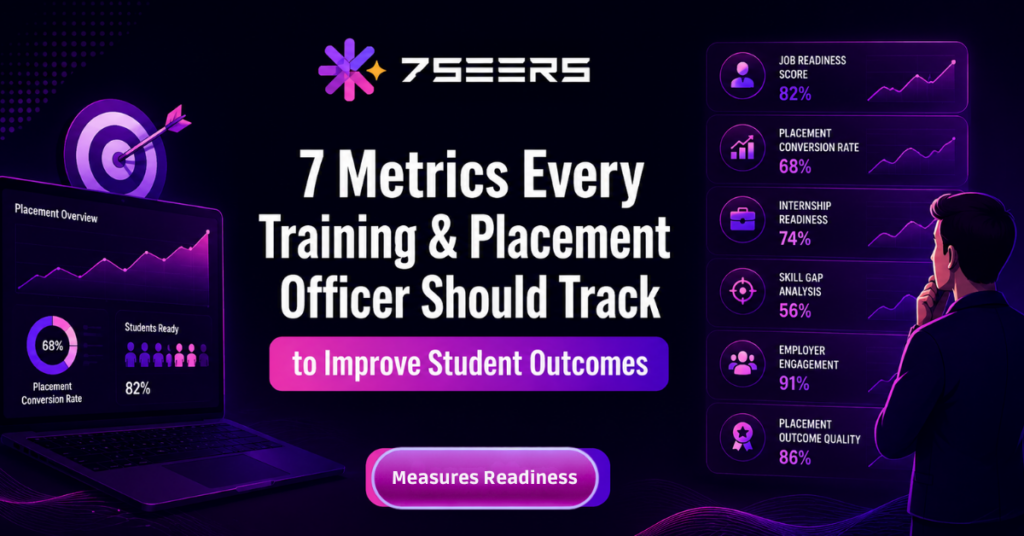
7 Training and Placement Metrics Every TPO Should Track to Improve Student Outcomes

Placements Are Not Won During Placement Season  Every Training & Placement Officer knows the feeling.  A major recruiter is scheduled to visit campus in two weeks. Students are attending last-minute aptitude sessions. Mock interviews are being rushed. Faculty members are coordinating schedules. Everyone is working toward the same goal: helping students secure opportunities.  But when the results arrive, the questions begin.  The answer often lies in the training and placement metrics institutions track long before recruiters arrive on campus. Why did some students perform exceptionally well while others struggled?  Why did technically strong candidates get rejected?  Why did only a fraction of interviewees convert into offers?  And perhaps the most important question: Could we have seen this coming earlier?  The reality is that placements aren’t won during placement season. They’re won months—sometimes years—before recruiters step onto campus.  The institutions consistently delivering strong placement outcomes are no longer relying solely on final placement numbers to measure success. Instead, they’re tracking the indicators that influence placement outcomes long before interviews begin.  Just as businesses rely on data to make decisions, placement teams need visibility into student readiness, skill gaps, employer engagement, and training effectiveness.  Because when you measure the right things, you can improve them.  Here are seven metrics every Training & Placement Officer should track to build a more effective, data-driven placement strategy.  1. Job Readiness Score: The Foundation of Placement Success  Imagine walking into placement season without knowing which students are actually prepared for interviews.  Unfortunately, that’s the reality for many institutions.  A student may have a strong academic record but struggle with communication. Another may be technically sound but lack confidence during interviews. Some students may be highly employable but unaware of how to present themselves professionally.  This is where a Job Readiness Score becomes invaluable.  Many institutions are now adopting frameworks such as the Job Readiness Index (JRI) to measure readiness before placement season. Rather than evaluating students on a single factor, a readiness score provides a comprehensive picture of employability by assessing areas such as:  Think of it as a health check-up for employability.  Instead of discovering weaknesses when a recruiter points them out, colleges can identify and address them much earlier.  Why It Matters  Without a readiness benchmark, placement efforts often become generic.  With a readiness score, placement teams can:  Most importantly, they can move from guessing who is ready to actually knowing.  2. Placement Conversion Rate: The Metric That Reveals the Real Story  Many institutions proudly share the number of students who participated in placement drives.  But participation doesn’t equal success.  A more meaningful metric is Placement Conversion Rate—the percentage of students who successfully convert interviews into offers.  Formula  Placement Conversion Rate = Offers Received ÷ Students Interviewed × 100  Let’s say:  The conversion rate would be 30%.  Now imagine another institution where only 250 students attended interviews but 125 secured offers.  Their conversion rate is 50%.  Which placement strategy appears more effective?  Exactly.  Why It Matters  Conversion rates reveal hidden insights about:  When tracked consistently, this metric helps TPOs identify patterns and improve future outcomes.  3. Internship Readiness: Because Careers Often Start Before Graduation  The traditional pathway from college to job is changing.  Today, internships have become one of the strongest gateways to employment.  Many organizations use internships as extended evaluation periods before offering full-time roles.  In fact, students who perform well during internships often receive Pre-Placement Offers (PPOs), giving them a significant advantage before placement season even begins.  The challenge?  Many students treat internships casually, while employers view them as auditions for future roles.  What Should Be Measured?  Internship readiness can include:  Why It Matters  A student who is internship-ready is often closer to being job-ready.  Tracking this metric helps institutions prepare students not just for interviews but for actual workplace success.  4. Skill Gap Analysis: Finding Problems Before Recruiters Do  Every recruiter looks for a combination of technical and professional skills.  The problem is that colleges often discover skill gaps only after students start getting rejected.  By then, valuable opportunities may already be lost.  Skill Gap Analysis helps placement teams compare student capabilities against industry expectations.  For example:  A software company may expect:  A student may possess strong coding skills but struggle during collaborative discussions.  Without visibility into these gaps, training efforts can miss the mark.  Why It Matters  Skill gap data enables institutions to:  Instead of offering ten generic workshops, colleges can deliver three targeted interventions that address actual needs.  5. Placement Readiness Progress Rate: Is Training Actually Working?  Institutions invest significant time and resources into training programs.  Aptitude sessions.  Soft skills workshops.  Interview preparation bootcamps.  Industry certifications.  But here’s the question:  How do you know if they’re making a difference?  This is where Placement Readiness Progress Rate becomes important.  Rather than measuring participation, it measures improvement.  For example:  This indicates meaningful growth.  Why It Matters  Tracking progress allows TPOs to:  Data-backed improvement is far more valuable than attendance records.  6. Employer Engagement & Repeat Recruiter Rate  One of the strongest indicators of placement quality isn’t student-related at all.  It’s employer behaviour.  When recruiters repeatedly return to a campus, they’re sending a message:  “We found talent worth hiring.”  Repeat Recruiter Rate measures how many employers choose to return year after year.  Why It Matters  Returning recruiters often indicate:  Building employer relationships is expensive and time-consuming.  Retaining those relationships is significantly more valuable.  For TPOs, this metric provides direct feedback from the market itself.  7. Placement Outcome Quality: Looking Beyond Placement Percentage  Placement percentage is important.  But it doesn’t tell the complete story.  Consider these two scenarios:  Institution A  Institution B  Which institution is delivering stronger long-term outcomes?  Most would choose Institution B.  That’s why placement teams should also track:  Why It Matters  Students aren’t just looking for jobs.  They’re looking for careers.  Tracking quality helps institutions align placements with long-term student success.  The Shift Every Placement Team Needs to Make  Traditionally, placement teams have focused on outcome metrics:  While these remain important, they are lagging indicators.  They tell you what happened. 

ALT Text: Fresher student building job readiness skills for 2026 campus placements
Blogs

5 Skills Employers Look for in Freshers in 2026 (And Why You Should Start Building Them Today)

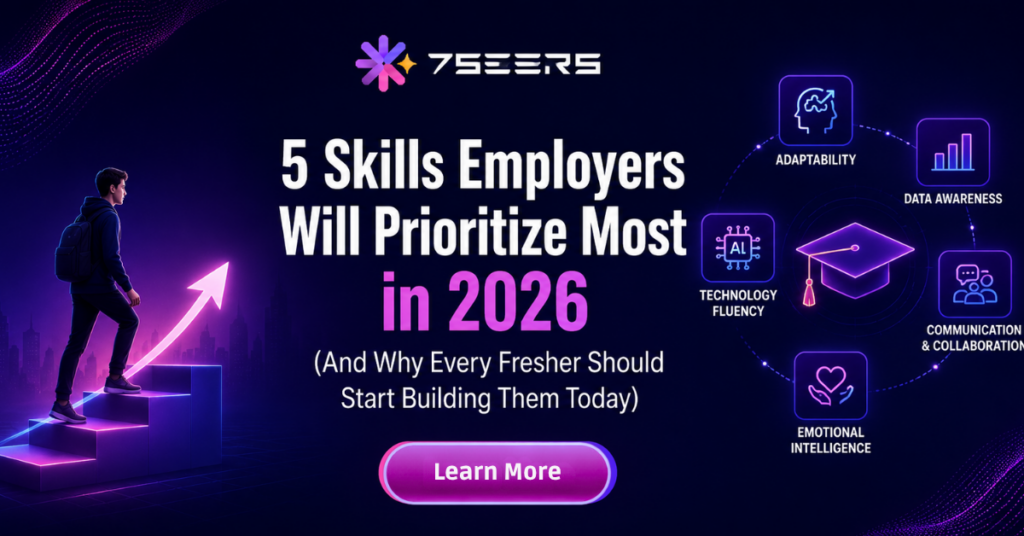
You did what everyone told you to do. You attended classes. Completed assignments. Worked on projects. Prepared for exams. And now, as graduation approaches, you’re probably asking the same question thousands of students ask every year: “Am I actually ready for a job?” It’s a fair question. Because understanding the skills employers look for in freshers has never been more important — especially as hiring evolves faster than most college curricula. Because the reality is that getting a degree and being job-ready are no longer the same thing. Today, recruiters aren’t just looking at your marksheet. They’re looking at your ability to learn, adapt, communicate, solve problems, and work with technology. In 2026, employability skills for freshers go far beyond academic scores. In fact, many hiring managers say they can teach someone a tool. What is much harder to teach is mindset. This creates both a challenge and an opportunity for freshers. The challenge is obvious: competition is increasing. The opportunity is that most students still focus only on academics. This reflects a broader challenge highlighted in our article on graduate employability in India, where academic achievement alone is no longer enough to secure meaningful employment. Those who build the right skills early often stand out during placements, internships, and interviews. So what exactly are employers looking for in 2026? Here are five skills that could make a significant difference in your career journey. Why Job Readiness Skills for Freshers Matter More Than Ever in 2026 Before diving into the five skills, it’s worth understanding why this conversation is happening now. The World Economic Forum’s Future of Jobs research consistently highlights that the fastest-growing roles require a combination of technical awareness and deeply human capabilities. For freshers entering campus recruitment and placement season, this means the bar has shifted — and knowing where you stand early can change everything. 1. Adaptability: The Employability Skill That Keeps Freshers Relevant If there’s one thing that defines today’s workplace, it’s change. New technologies appear every few months. Job roles evolve. Industries transform. What was relevant two years ago may not be enough today. For freshers entering the workforce, adaptability has become one of the most sought-after job readiness skills. As a fresher, this can feel overwhelming. You spend years learning something, only to hear that AI or automation is changing the way the industry works. But here’s the good news. Employers don’t expect freshers to know everything. They expect them to be willing to learn. What Does Adaptability Look Like in an Entry-Level Job? Imagine two graduates joining the same company. One complains every time a new software tool is introduced. The other sees it as an opportunity to learn. A year later, who do you think has grown faster? Usually, it’s not the person with the highest marks. It’s the person who adapted. How You Can Build Adaptability Learn skills beyond your curriculum. Explore new technologies even when they aren’t required. Take online courses regularly. Be comfortable saying, “I don’t know yet, but I can learn.” The students who succeed in the coming years won’t be the ones who know everything. They’ll be the ones who can learn anything. 2. Data Awareness: A Must-Have Skill for Fresh Graduates in Every Field Data isn’t just for analysts anymore. Regardless of your field, data literacy is now considered a core workplace skill for fresh graduates. Whether you’re entering marketing, HR, finance, operations, sales, or even content creation, data influences decisions everywhere. As a fresher, you don’t need to become a data scientist. But you should understand how to use information to support your ideas. Why Data Literacy Matters Even for Non-Technical Freshers Imagine an interviewer asks: “What impact did your college project have?” One student says: “We created a social media campaign.” Another says: “Our campaign increased engagement by 35% over six weeks.” Who sounds more convincing? The second student. Why? Because they understand outcomes. Numbers add credibility. Employers love candidates who can connect actions to results. How You Can Build Data Awareness Learn Excel or Google Sheets. Understand basic metrics relevant to your field. Use numbers when discussing projects. Practice reading reports and dashboards. Data won’t replace creativity. But it will strengthen your decisions. 3. Technology Fluency: How Freshers Can Build AI Skills for the Modern Workplace One of the biggest concerns among students today is AI. Many freshers worry: “Will AI take my job?” A better question might be: “How can AI help me do my job better?” But technology fluency — the ability to work comfortably with digital tools and AI — is increasingly a baseline expectation in entry-level hiring. The workplace is becoming increasingly digital. From project management tools to AI assistants, technology is becoming part of everyday work. The graduates who understand this will have a major advantage. Technology Fluency vs. Technical Skills: What’s the Difference? Two interns receive the same assignment. One spends five hours manually researching information. The other uses AI tools to gather insights faster and spends more time improving the quality of the final output. Who creates more value? Usually, the second person. Employers don’t reward effort alone. They reward outcomes. How You Can Build Technology Fluency Learn how AI tools work. Explore productivity platforms. Use digital collaboration tools. Stay curious about emerging technologies. You don’t need to become a programmer. You simply need to become comfortable with technology. 4. Communication and Cross-Cultural Collaboration: Why Employers Rank It Among Top Workplace Skills One misconception many students have is that communication means speaking fluent English. In reality, communication is much broader. It’s about expressing ideas clearly. It’s about listening. It’s about understanding different perspectives. And increasingly, it’s about collaborating with people from different cities, countries, and cultures. Remote Work and Cross-Cultural Teams: A Reality for Today’s Freshers Imagine you’re working remotely with teammates from Bengaluru, Singapore, and London. Everyone has different working styles. Different communication habits. Different expectations. Your ability to collaborate effectively becomes just as important as your technical skills. This is why employers

Blogs

AI Hiring in India: Why Traditional Resumes Are Failing in the Modern Recruitment Era

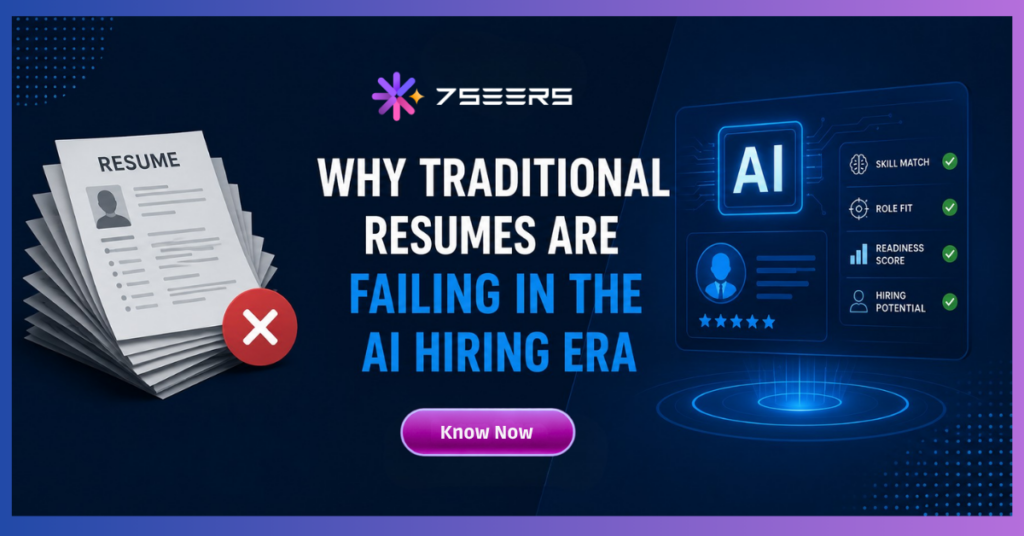
Hiring has changed.But most resumes haven’t. For decades, resumes followed the same formula: a one-page PDF, a list of skills, some percentages, a few buzzwords, and a hope that a recruiter would notice. That system worked when recruiters manually reviewed applications one by one. Today, that is no longer how hiring operates. Modern recruitment is driven by AI-powered screening systems, Applicant Tracking Systems (ATS), skill-matching engines, and automated shortlisting workflows. In this environment, traditional resumes are failing in the AI hiring era – and institutions that continue preparing students with outdated resume formats are unknowingly reducing their placement potential. The Problem with Traditional Resumes in AI Hiring 1. Traditional Resumes Focus on Information, Not Intelligence Most resumes are static documents. They tell recruiters what a student has done, but not how relevant those experiences are for a particular role. A recruiter today is not looking for generic claims like: They are looking for measurable alignment: Traditional resumes cannot answer these questions effectively. 2. ATS Systems Reject Poorly Structured Resumes Most companies today use ATS software before a human recruiter even sees an application. If a resume: it often gets filtered out automatically. This means many capable students never even reach the interview stage. The harsh reality: A resume is no longer written only for humans.It must first pass through machines. 3. Resume Similarity Creates Candidate Invisibility Thousands of resumes now look identical. Recruiters reviewing hundreds of applications experience “resume fatigue,” where profiles blur together because they lack differentiation. In a competitive hiring market, similarity becomes invisibility. 4. Resumes Do Not Reflect Real Job Readiness A student may have: but traditional resumes fail to quantify actual readiness. There is no clear signal for: As a result, recruiters rely heavily on screening tests and interviews instead of trusting resumes alone. The Shift from Resume-Based Hiring to Readiness-Based Hiring Hiring is evolving toward intelligence-driven evaluation. Companies increasingly want: This shift is closely aligned with the growing focus on employability and measurable readiness, as explored in Graduate Employability in India This is where next-generation ATS systems become critical. How the 7Seers ATS System Solves This At 7Seers, we believe resumes should evolve from static documents into dynamic employability profiles. Our ATS and placement intelligence system is designed not just to store resumes — but to understand candidates. What Makes the 7Seers ATS Different? AI-Based Resume Intelligence Instead of simply parsing PDFs, the system evaluates: This helps institutions identify: Smart Matching for Recruiters Recruiters no longer need to manually filter hundreds of resumes. The ATS intelligently maps candidates based on: This significantly improves hiring efficiency. Readiness Scores Instead of Generic Profiles Traditional resumes say: “Student knows Python.” The 7Seers ATS asks: The result is a measurable readiness score that provides deeper insight than a static resume ever could. This approach complements the broader concept of the Job Readiness Index (JRI), discussed inHow Universities Can Measure Student Job Readiness Using AI Institution-Level Placement Intelligence For colleges and universities, resumes are often fragmented across departments and spreadsheets. Our ATS centralizes: This helps institutions move from reactive placements to strategic workforce readiness. The Future of Hiring Is Not Resume-First The future belongs to: Students need more than resumes.Institutions need more than placement spreadsheets.Recruiters need more than keyword filtering. The hiring ecosystem needs intelligence. And that is exactly what modern ATS systems are built to deliver. Final Thoughts on AI Hiring and Employability Traditional resumes were built for a different era. In today’s AI-driven hiring landscape, static resumes are no longer enough to represent a candidate’s true potential. The institutions that adapt early — by adopting intelligent ATS and employability systems — will produce graduates who are not only qualified on paper, but genuinely workforce-ready. At 7Seers.ai, we are building that future.

Accredition in Job readiness
Blogs

Why Job Readiness Is the New Metric of Institutional Success? 

Today, a degree alone no longer guarantees a career. What matters is whether students are job-ready—equipped not only with theoretical knowledge but also with the skills, behaviors, and mindset to meet industry expectations from day one.  As employers look beyond academic scores, job readiness in higher education has emerged as a key performance indicator for institutions. From curriculum design to teaching methodologies, everything is being re-evaluated to ensure alignment with market realities.  But how can institutions deliver on this new expectation?  The Reality: A Persistent Skill Gap in Higher Education  Despite a rise in graduation rates, a large percentage of students struggle to find relevant employment. This reflects a skill gap in higher education—a disconnect between what’s taught and what’s demanded by employers.  The gap isn’t just technical. Communication, critical thinking, adaptability, and real-world exposure are areas where students often fall short. This mismatch hampers graduate employability metrics, impacting both the individual and the institution’s standing in rankings and reputation.  Enter 7Seers: Your Partner in Job-Ready Transformation  7Seers is not just an EdTech platform—it’s an AI-powered education transformation solution that redefines how institutions prepare students for the future.  Here’s how 7Seers helps build future-ready curriculum design –  1. AI in Education for Personalized Learning Paths  Every student learns differently. 7Seers uses AI-driven learning outcomes and predictive analytics in education to customize learning journeys. Based on individual performance, learning style, and career goals, it recommends content, projects, and skill development tracks to maximize engagement and results.  2. Skill Mapping and Employability Tracking  Institutions can now track real-time progress on graduate employability metrics. Through skill assessments, internship readiness indicators, and placement outcomes, educators get actionable data to fine-tune programs.  3. AI-Powered Career Guidance Tools  Students receive intelligent suggestions for potential career paths based on their interests, strengths, and market trends. These AI-powered career guidance tools go beyond generic counselling, offering data-backed recommendations tailored to each learner.  4. Strengthening Industry-Academia Collaboration  7Seers enables deeper partnerships between academia and industry through:  This ensures students gain relevant exposure and hands-on experience that reflects real-world scenarios.  Institutions That Prioritize Job Readiness Will Lead  With job readiness now central to student success, accreditation, and rankings, it’s no longer optional. It’s strategic.  7Seers empowers institutions to embed future-ready learning into their DNA—delivering outcomes that matter to students, employers, and society at large.  Let’s redefine success—one job-ready graduate at a time. 

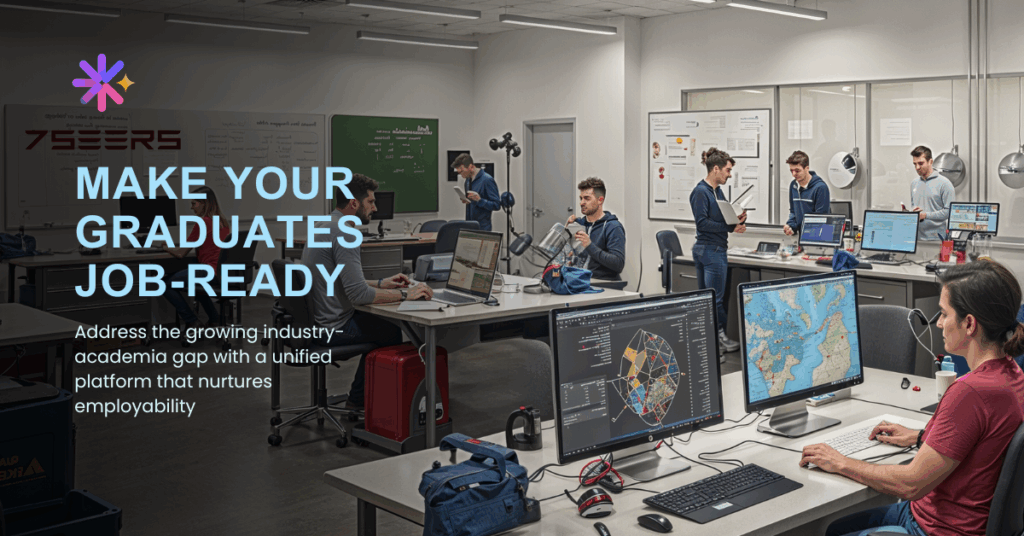
Students using 7Seers platform in a smart classroom with real-time job readiness tools, bridging the industry-academia gap
Blogs

Empowering Educational Ecosystems: The Need for Job-Ready Graduates 

The transition from classroom learning to corporate readiness is no longer a luxury—it’s a necessity. According to the World Economic Forum, over 50% of all employees will need reskilling by 2025. Meanwhile, more than 85 million jobs may go unfilled by 2030 due to a lack of skilled talent (Korn Ferry).  Are educational institutions truly ready to bridge this gap?  This is where 7Seers steps in. It’s not just a product—it’s a movement to align academia with industry expectations by empowering all stakeholders: students, teachers, Training & Placement Officers (TPOs), and administrators.  For Students: AI-Driven Career Preparation Starts Early  Classroom lectures alone can’t prepare students for interviews, projects, or performance in real-time work environments. Here’s what 7Seers offers:  For Teachers: Support for Creating Industry-Driven Classrooms  Teaching is no longer limited to just academic books. Educators need to mentor students for real-world jobs.  For Training & Placement Officers: From Manual Tracking to Smart Operations  With hiring trends changing rapidly, institutions must equip TPOs with tools for real-time decision-making.  Why Institutions Trust 7Seers?  Because it’s more than a digital portal—it’s a strategic transformation partner.  Global Snapshot: Why This Change is Urgent  Conclusion:  Educational institutions have a new mandate—not just to teach, but to transform.  Platforms like 7Seers make this shift possible—by empowering every stakeholder with intelligent tools, real-time data, and outcome-based guidance.  The question is: Is your institution ready for the change? 

7Seers unified career readiness and placement platform for colleges"
Blogs

Is Your Campus Really Job-Ready? Let’s Find Out

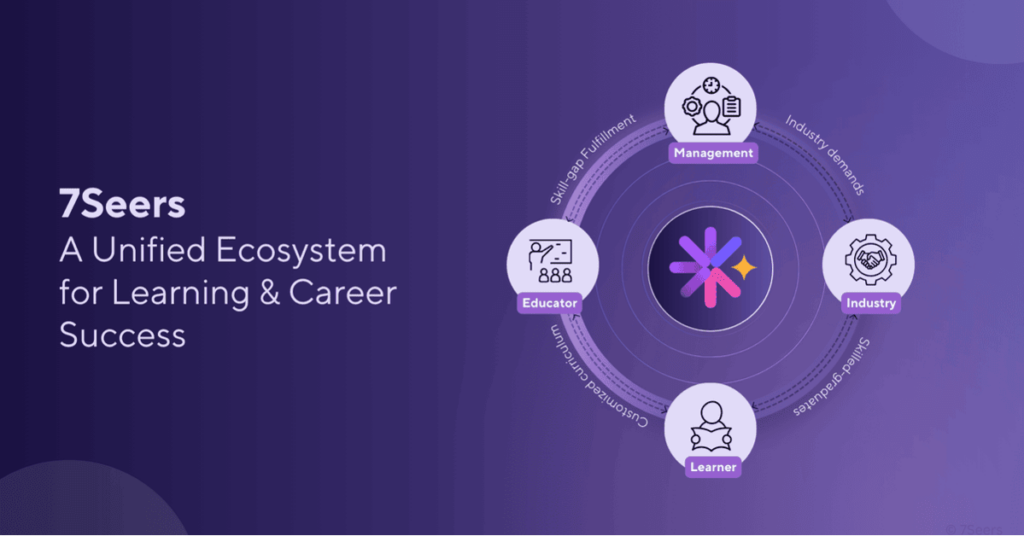
You’re a student, a teacher, a TPO, or part of the academic leadership team. You’re invested in outcomes. But let’s ask the hard question:  Is your institution truly preparing students for what comes after graduation?  All check out. But here’s what’s often missing:  Now let’s flip the script.  What if there was one unified platform that powered all of this—and it’s already transforming campuses across the country?  Meet 7Seers—a platform that aligns every stakeholder in your education ecosystem to one goal: making students job-ready before they leave campus.  Let’s walk through it, stakeholder by stakeholder.  Student: “I need more than just lectures. I need real-world prep.”  You want to land that job—but you’re stuck between theory-heavy classes and scattered prep resources. What if you had one place that did it all?  With 7Seers, you get –  Your Outcome – Not just prepared. Prepared smartly, specifically, and confidently.  Teacher: “I teach—but how do I align with industry trends?”  Let’s test this –  With 7Seers, now you can –  Your Outcome – You become a career coach, not just a curriculum expert.  Training and Placement Officer: “Too many moving parts. Not enough visibility.”  Let’s simulate your current process. You’re juggling resumes, interviews, company data, training sessions, student follow-ups… sound familiar?  Now think of this –  You’re no longer managing placements. You’re managing predictive employability.  Your Outcome – Smarter placements. Less challenges. More conversions.  Institutional Leadership: “How do we stand out?”  Here’s what 7Seers can bring for your institution –  Your Outcome – Become a next-gen institution that delivers outcomes, not just infrastructure.  Let’s Recap—Quick Quiz Time –  Which of these do you currently have in place?  If you ticked fewer than four—your institution needs 7Seers.  Every student deserves a smart, guided path to employment. Every institution deserves tools that make that path possible.   That’s 7Seers.  Want to see how it fits your campus? Request a live walkthrough or connect with our onboarding team. 

5 Ways how AI is Transforming Education Worldwide
Blogs

5 Ways AI is Transforming Education Worldwide

Old vs. New: Is Our Education System Keeping Up with the World? For centuries, education has followed a standardized model—a system where students learn at the same pace, in the same way, regardless of their unique abilities or interests. This traditional approach has shaped millions of minds but has also created gaps between education and real-world skills. With the rapid advancement of technology, AI, and global digital transformation, education needs to evolve. Countries like Finland, Singapore, and the U.S. are already adopting flexible, skills-based, and AI-driven education models, whereas India and other developing nations are still in transition. Let’s take a closer look at how the old education system compares to today’s evolving learning ecosystems. Old vs. New: A Global Shift in Education Aspect Traditional Education (Old) Modern Learning Ecosystem (New – 7Seers Approach) Teaching Method One-size-fits-all, rote learning Adaptive, personalized learning paths using AI Focus Memorization, theoretical knowledge Skill-based, real-world application Student Engagement Passive learning (lectures, textbooks) Interactive learning (gamification, simulations, projects) Assessment System Standardized exams, marks-based Continuous assessment, competency-based evaluation Technology Integration Minimal, mostly classroom-based AI, digital platforms, virtual learning, immersive experiences Industry Readiness Limited, outdated curriculum Industry-academia collaboration, real-world skills Access to Learning Geographically limited, classroom-dependent Anytime, anywhere, digital-first education Feedback Mechanism Delayed, general feedback Real-time AI-driven insights, customized learning paths The Shift in Global Education Models In India, education is still heavily dependent on traditional classrooms and standardized testing, but change is happening.Countries like Finland, Singapore, and the U.S. are leading the way with student-centric learning models, AI-driven customization, and real-world skill integration. India’s Education Evolution United States & Europe Singapore & Finland (Leading Models) Building the Future of Education with 7Seers Is Our Education System Ready for the Future? For decades, education has followed a standardized syllabi, one-size-fits-all teaching methods, and evaluation systems that focus more on memorization than actual understanding. While industries have embraced digital transformation, education has been slow to evolve, leaving students unprepared for the demands of the modern workforce. With rapid advancements in AI, automation, and global connectivity, learning needs to be more than just textbooks and lectures. It should be engaging, adaptive, and relevant to real-world applications. This is where 7Seers comes in—a revolutionary education platform designed to bridge the gap between traditional learning and industry expectations. The Vision Behind 7Seers 7Seers is built on a simple yet powerful idea –Every learner is unique. Their education should be too. Rather than forcing students into a fixed curriculum, 7Seers adapts to individual learning styles, strengths, and interests. It brings a personalized, interactive, and skill-based approach to education, ensuring students don’t just learn but truly understand, apply, and innovate. Key Features of 7Seers 1. Personalized Learning Paths Not all students learn at the same pace or in the same way. 7Seers leverages AI to assess each student’s strengths, weaknesses, and preferences. Based on this, the platform creates a customized learning journey, ensuring a more effective and enjoyable education experience. 2. Skill-Based Learning Over Memorization The modern job market values problem-solving, creativity, adaptability, and critical thinking over rote learning. 7Seers emphasizes: Students gain not just theoretical knowledge but practical skills that prepare them for careers in technology, business, healthcare, and more. 3. Interactive and Engaging Education Traditional classrooms rely on passive learning—lectures, note-taking, and exams. 7Seers introduces active learning through: By making learning an experience rather than a chore, students retain information better and develop a lifelong love for learning. 4. Industry-Academia Collaboration Education should not exist in isolation from industry needs. 7Seers bridges this gap by: This ensures students graduate not just with degrees but with real, marketable skills. 5. Insights for Educators and Management Teachers and institutions often struggle to track student progress effectively. 7Seers provides data-driven insights to help educators: With AI-driven analytics, educators can make more informed decisions and enhance student learning outcomes also management can understand the trends in real-world employment landscape to help students get job-ready. Why 7Seers Matters Now More Than Ever? The education system is at a turning point. The traditional model is no longer sufficient to prepare students for an uncertain future. With automation and AI reshaping industries, learning needs to evolve from static information consumption to dynamic, skill-driven engagement. 7Seers is not just a platform—it’s a movement towards a smarter, more adaptive, and future-ready education system. Join the Education Revolution Education should be about understanding concepts, solving problems, and thinking critically. If you’re a student, educator, or institution looking for a smarter way to learn and teach, 7Seers is the future you’ve been waiting for. What’s the one thing you would change about today’s education system? Let’s discuss.

The Advent of AI and Rethinking Learning Through Bloom’s Taxonomy
Blogs

The Advent of AI and Rethinking Learning Through Bloom’s Taxonomy | 7Seers

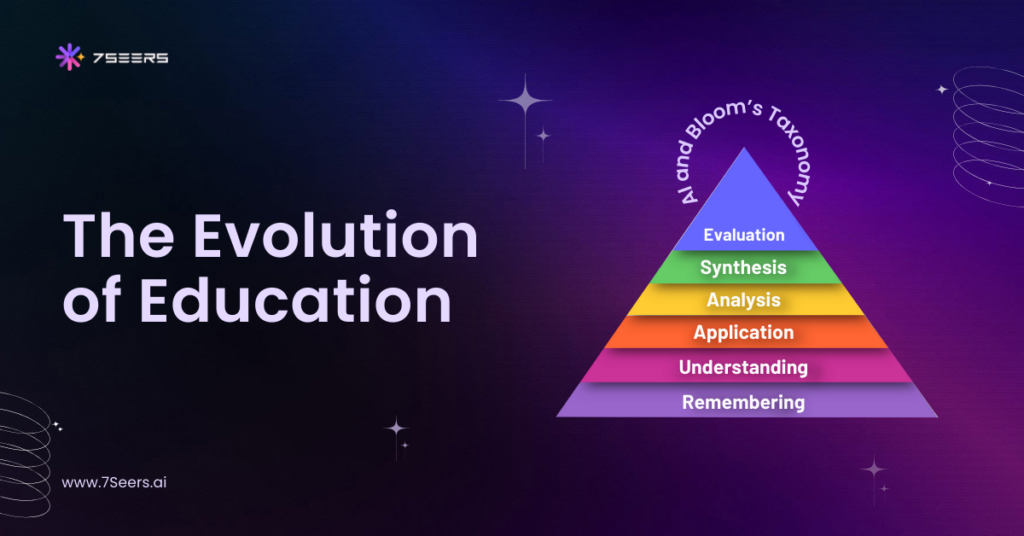
The rise of generative AI tools like ChatGPT, DALL·E, and others has transformed how we approach learning, creativity, and problem-solving. These tools have made the act of creation remarkably accessible—allowing anyone to generate text, images, videos, or even 3D models with minimal effort. But what does this mean for education, particularly in the context of Bloom’s Taxonomy, a framework that has guided educators for decades? For those familiar with it, Bloom’s Taxonomy organizes learning into six levels: 1. Remembering – recalling facts and concepts, 2. Understanding – explaining ideas, 3. Applying – using knowledge in new situations, 4. Analyzing – breaking down information into components, 5. Evaluating – making judgments based on criteria, 6. Creating – producing new or original work. Traditionally, these levels represent a progression, with “creating” as the pinnacle of cognitive achievement. But with AI making creation easier than ever, it’s time to rethink this hierarchy. AI and the Shift in Learning Dynamics Generative AI flips the traditional progression on its head. When students can instantly generate essays, images, or prototypes, “creating” is no longer a culmination of learning—it becomes the starting point. This forces educators to ask: • How do we ensure that students still engage in deep learning? • What cognitive skills become more critical in an AI-enabled world? One possible answer lies in Reverse Bloom’s Taxonomy, a concept that encourages starting with creation and working backward through the cognitive levels. Reverse Bloom’s Taxonomy in Action In this new model: 1. Create: Students use AI to generate content—an essay, design, or project prototype. 2. Evaluate: They critically assess the AI-generated work for accuracy, coherence, and relevance. 3. Analyze: Students break down the output, identifying flaws, biases, or underlying assumptions. 4. Apply: They modify or adapt the AI output for a specific context or problem. 5. Understand: Students explore how the AI generated the output and explain its logic or process. 6. Remember: Finally, they internalize key insights, tools, and techniques for future use. Why Reverse Bloom’s Taxonomy Matters Generative AI shifts the focus from manual creation to critical evaluation and thoughtful curation. Here’s why this approach is transformative: 1. Encourages Critical Thinking: Students engage deeply with AI outputs, evaluating and improving them rather than passively accepting them. 2. Builds Meta-Cognition: Understanding how AI tools work and their limitations fosters lifelong learning skills. 3. Promotes Active Learning: Students become active participants in the learning process, rather than mere recipients of knowledge. 4. Redefines Creativity: Creativity shifts from starting from scratch to enhancing, contextualizing, and refining AI-generated work. 5. Prepares for the Future: In a world where AI will be ubiquitous, the ability to guide, evaluate, and collaborate with AI systems is a critical skill. Practical Applications for Educators 1. AI-Assisted Projects: Assign tasks where students use AI to create initial drafts or prototypes, followed by deeper analysis and refinement. 2. Critical Evaluation Exercises: Present students with flawed AI-generated outputs and ask them to critique and improve them. 3. Simulated Scenarios: Use AI to generate case studies, datasets, or problem scenarios for students to solve. 4. Cross-Disciplinary Learning: Encourage the use of AI tools in various subjects, from writing to STEM to the arts, to foster well-rounded cognitive development. Challenges to Consider While Reverse Bloom’s Taxonomy holds promise, implementing it comes with challenges: • Verification Drift: Even after strict guidelines are provided to students to critically reflect on the usage and substantiate AI-generated content with credible sources, they may not be sufficient to ensure accuracy and ethical AI use in practice. GenAI users are aware of the technology’s limitations and understand the need to verify AI-generated content. However, as they review the material, the authoritative tone and polished presentation of GenAI gradually lead them to perceive it as reliable, ultimately making verification seem unnecessary. Educators need to go beyond just providing instructions on AI usage; they should actively engage students in responsible GenAI practices, provide ongoing feedback, and, most importantly, showcase real examples of situations where AI-generated content has been misleading or wholly fabricated. • Missing pain of discovery: The discovery and thinking process is less painful due to the ease of creation. Learning is a part of this process, and in the absence of such a process, it’s not clear whether critical thinking might get lost. • Conformity and lack of variance in thinking: The generated content depends on the gen AI models being trained on currently available data on the internet or synthetically generated data. This data is skewed towards a part of the advanced society and a few countries with high levels of digitization. Any generated content is thus a representation of the thought process, culture, literature, and people who inherently have an advantage in the age of AI and under-representation of a lot of poor populations or less advanced countries not yet entirely digitized. Starting with such content naturally skews student’s subsequent thoughts to conform to this thought process. • Censorship: Since governments are realizing the importance of generative AI models influencing the narratives, there is a growing tendency to censor foundational models based on bias. This again adds complexity to the generated content and, depending on the model used, adds an inherent bias to the starting content. • Ethical Concerns: How do we ensure students don’t over-rely on AI, bypassing critical thinking altogether?  • Assessment: Traditional methods of grading may not align with this new approach. • Equity: Not all students have equal access to advanced AI tools, which could exacerbate the digital divide. A Call to Action for Educators Generative AI has profoundly disrupted education, but it’s also a tremendous opportunity. By rethinking learning through the lens of Reverse Bloom’s Taxonomy, we can equip students with the skills they need to thrive in an AI-driven world: critical thinking, adaptability, and creative judgment. The question isn’t whether AI will change education—it already has. The question is how we, as educators, innovators, and lifelong learners, will adapt to ensure that this change leads to meaningful growth. How will you embrace Reverse Bloom’s Taxonomy in your classroom or organization? Let’s start the conversation.

Scroll to Top