For years, institutions were evaluated based on what they offered: a sprawling campus, well-equipped laboratories, experienced faculty, and a structured curriculum. While these factors continue to matter, they are no longer enough to define institutional excellence.
Higher education is entering an era where outcomes carry greater weight than intentions.
Students no longer choose colleges based solely on rankings or infrastructure. Parents no longer ask only about faculty strength. Recruiters certainly aren’t hiring because a university has a beautiful campus.
Everyone is asking the same question:
What kind of graduates does this institution produce?
This is precisely where the National Assessment and Accreditation Council (NAAC) has shifted its focus.
NAAC has shifted the way it evaluates institutions in today’s world; outcomes and results are more valuable than compliance and activities.
What Is Changing in NAAC Accreditation 2026?
NAAC Accreditation 2026 places greater emphasis on measurable student outcomes, employability, Outcome-Based Education (OBE), placement readiness, and continuous institutional improvement rather than infrastructure and compliance alone.
But why did the need arise for this Shift?
Higher education is no longer operating in the same environment it did a decade ago. Students have access to unlimited learning resources online, industries are evolving faster than traditional curricula, and employers expect graduates to contribute from day one. In such a dynamic ecosystem, evaluating institutions solely on infrastructure, faculty strength, or academic processes no longer paints a complete picture of educational quality. What matters is whether students leave the institution equipped with the knowledge, skills, and confidence to succeed in the real world.
This changing reality is what has driven NAAC to place greater emphasis on outcomes. The shift reflects a broader recognition that education must be measured by its impact rather than its intent. Institutions are now encouraged to demonstrate how effectively they nurture student growth, improve employability, foster innovation, and contribute to society. By focusing on outcomes instead of activities alone, NAAC aims to promote a culture of accountability, continuous improvement, and student-centric excellence across higher education.
1. NAAC Has Shifted to an Output-First Approach
The criteria to evaluate universities have changed.
Institutions are no longer evaluated only on infrastructure, facilities, or academic processes. Increasingly, the focus is on the quality of graduates they produce and whether students are prepared to succeed beyond the classroom.
Questions that matter today include:
- Are students employable?
- Are they equipped with industry-relevant skills?
- Can they adapt to changing technologies?
- Do they possess communication and problem-solving abilities?
- Are they securing meaningful internships and placements?
In other words, educational inputs alone are no longer sufficient. Institutions are expected to demonstrate measurable outcomes.
A modern university is not defined by the number of classrooms it has.
It is defined by the number of students who walk out of those classrooms prepared for the real world.
2. Student Success Is the Strongest Measure of Institutional Success
For decades, higher education primarily focused on delivering knowledge, but things have changed today; knowledge is widely accessible and available everywhere.
Students can learn programming from online platforms, study finance through digital courses, and even understand complex technologies using AI-powered learning tools.
This has fundamentally changed the role of higher education. Universities are no longer expected to teach students straight out of a curriculum. They are expected to create transformation by adopting practical teaching.
Transformation means students graduate with:
- Practical skills
- Critical thinking abilities
- Confidence
- Industry exposure
- Professional communication
- Career clarity
The success of an institution is increasingly reflected in the success of its graduates.
Every placement offer, internship opportunity, startup launched, or student pursuing higher education becomes evidence of institutional impact.
This is exactly the kind of evidence accreditation bodies seek.
3. Employability Has Become a Core Academic Outcome
One of the biggest shifts in higher education is the growing connection between academics and employability. A degree alone no longer guarantees employment. Recruiters are looking for graduates who can contribute from day one.
They expect candidates who can:
- Solve business problems.
- Work collaboratively.
- Communicate effectively.
- Adapt to AI-enabled workplaces.
- Learn continuously.
Consequently, institutions must move beyond academic completion and begin measuring career readiness.
This includes tracking:
- Resume quality
- Internship participation
- Technical competencies
- Communication skills
- Mock interview performance
- Placement readiness
Employability should no longer be viewed as the responsibility of the placement cell alone. It should become a shared institutional objective.
This institutional shift reflects a larger conversation around graduate employability in India, where universities are increasingly measured by the career outcomes of their students rather than academic completion alone.
4. Outcome-Based Education Is No Longer Optional
Higher education is undergoing a significant transformation, and Outcome-Based Education (OBE) is at the heart of it. Rather than measuring success by the number of lectures delivered or chapters completed, OBE focuses on what students are actually able to achieve by the end of their academic journey.
This approach encourages institutions to define clear learning outcomes for every programme and continuously assess whether those outcomes are being met. It shifts the focus from teaching to learning, ensuring that education translates into practical knowledge, critical thinking, and real-world application.
For institutions, this means creating a learning ecosystem where classroom instruction, industry exposure, internships, projects, and assessments all contribute towards developing competent graduates. More importantly, it requires regular evaluation and improvement based on evidence rather than assumptions.
NAAC’s emphasis on outcome-based education reflects this broader vision. Institutions are expected to demonstrate that their academic practices lead to measurable improvements in student learning, employability, and overall development. In today’s accreditation landscape, documenting outcomes is just as important as delivering quality education.
5. Data Is Becoming the New Evidence
Institutional decisions can no longer rely on assumptions. Leadership teams need measurable evidence.
Questions such as:
- Which departments have the highest placement readiness?
- Which students require additional support?
- Which employability skills need improvement?
- Which interventions are producing results?
cannot be answered through manual tracking alone. This is where analytics become essential. Institutions that continuously monitor student progress are able to make timely interventions instead of reacting during placement season.
Many institutions are now adopting frameworks like the Job Readiness Index (JRI) to measure student readiness continuously and identify skill gaps before they impact placement outcomes.
More importantly, they possess credible evidence during accreditation. Data transforms institutional improvement from guesswork into strategy.
6. Placements Begin Long Before Recruitment Season
One of the biggest misconceptions in higher education is that placement preparation begins in the final year. In reality, successful placements are the outcome of preparation that starts much earlier.
Students need time to:
- Build technical skills
- Develop communication abilities
- Create professional resumes
- Practice interviews
- Receive constructive feedback
- Improve consistently
Waiting until recruitment drives begin often results in rushed preparation and missed opportunities.
Institutions that invest in continuous placement readiness create stronger outcomes because students improve gradually over time rather than preparing at the last moment.
7. Preparing Students Is Preparing the Institution
An institution’s reputation is ultimately shaped by the success of its students. Every student who secures a placement, excels in higher education, launches a startup, or makes a meaningful impact in their profession becomes a reflection of the institution’s quality. Strong student outcomes build trust among prospective students, strengthen employer relationships, and reinforce an institution’s standing during accreditation and ranking exercises.
This is why investing in student development is no longer just a placement initiative; it’s an institutional strategy. By continuously tracking skill development, career readiness, and learning progress throughout a student’s academic journey, institutions can identify gaps early, provide timely support, and create better outcomes. When students succeed, institutions don’t just improve their placement statistics; they build a stronger brand, attract better opportunities, and create a lasting legacy of excellence.
How Students Can Prepare for an Outcome-Driven Future
While institutions play a crucial role in shaping student outcomes, students themselves must take ownership of their career journey. The job market is evolving faster than ever, and waiting until the final semester to start preparing is no longer enough. Consistent effort throughout college can make all the difference when placement season arrives.
Here are a few ways students can stay ahead:
- Build industry-relevant skills: Go beyond classroom learning by exploring certifications, online courses, and practical projects that align with your career goals.
- Practice before the real interview: Mock interviews and regular assessments help you identify areas of improvement and build confidence before facing recruiters.
- Keep your resume updated: Your resume is often your first introduction to an employer. Make sure it’s ATS-friendly, highlights measurable achievements, and reflects your latest skills and experiences.
- Stay informed about industry trends: Follow developments in your chosen field, understand emerging technologies like AI, and know what employers are looking for.
- Seek feedback and improve continuously: Every assessment, interview, or project is an opportunity to learn. Use feedback to refine your skills rather than waiting for placement season.
Students who prepare and practice consistently are more likely to stand out in a competitive hiring landscape.
The Role of Technology in Outcome Tracking
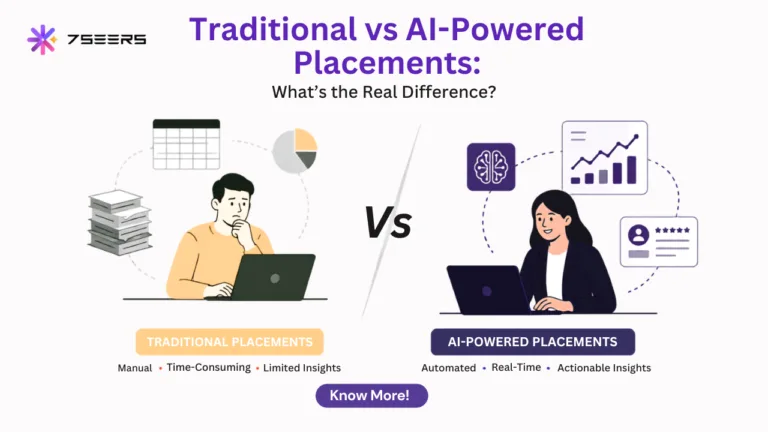
As institutions grow in size and student diversity, manually tracking academic progress and employability outcomes becomes increasingly challenging. Spreadsheets and scattered records may help maintain data, but they often fail to provide meaningful insights into how students are progressing or where timely interventions are needed. In an outcome-driven education system, institutions require more than data; they need visibility.
Technology bridges this gap by enabling institutions to monitor student development in real time. From tracking skill assessments and internship participation to monitoring placement readiness and career progression, digital platforms provide a comprehensive view of each student’s journey. Instead of waiting until the final year to evaluate employability, institutions can identify learning gaps early and provide targeted support throughout the academic lifecycle.
Beyond improving operational efficiency, technology also simplifies evidence collection for accreditation and quality assurance processes.
Dashboards, reports, and performance analytics help institutions measure progress against predefined outcomes while providing reliable documentation to support institutional reviews. Tracking the right training and placement metrics enables institutions to move beyond reporting and make proactive decisions that improve student outcomes throughout the academic journey.
More importantly, these insights empower academic leaders, faculty, and placement teams to make informed decisions that directly improve student success.
As higher education becomes increasingly data-driven, technology is no longer just a support function; it’s becoming a strategic partner in helping institutions deliver measurable outcomes. Those that embrace digital tools today will be better equipped to meet accreditation expectations while ensuring every student receives the guidance needed to thrive academically and professionally.
The Road Ahead
The future of higher education will not be defined solely by academic excellence. It will be defined by measurable student outcomes.
Institutions that can demonstrate employability, skill development, career readiness, and continuous student growth will be better positioned to meet evolving accreditation expectations and industry demands.
Preparing students for this future requires visibility into their progress not just during placement season, but throughout their academic journey.
This is where technology can play a meaningful role.
Platforms like 7Seers enable institutions to measure and improve placement readiness through AI-powered mock interviews, resume analysis, skill assessments, and readiness dashboards. Instead of relying on assumptions, institutions gain actionable insights into where students stand and how they can be supported before recruiters arrive on campus.
Because at the end of the day, NAAC isn’t simply evaluating processes.
It is evaluating outcomes.
And the strongest outcome any institution can showcase is the success of its students.