Placements Are Not Won During Placement Season
Every Training & Placement Officer knows the feeling.
A major recruiter is scheduled to visit campus in two weeks. Students are attending last-minute aptitude sessions. Mock interviews are being rushed. Faculty members are coordinating schedules. Everyone is working toward the same goal: helping students secure opportunities.
But when the results arrive, the questions begin.
The answer often lies in the training and placement metrics institutions track long before recruiters arrive on campus.
Why did some students perform exceptionally well while others struggled?
Why did technically strong candidates get rejected?
Why did only a fraction of interviewees convert into offers?
And perhaps the most important question: Could we have seen this coming earlier?
The reality is that placements aren’t won during placement season. They’re won months—sometimes years—before recruiters step onto campus.
The institutions consistently delivering strong placement outcomes are no longer relying solely on final placement numbers to measure success. Instead, they’re tracking the indicators that influence placement outcomes long before interviews begin.
Just as businesses rely on data to make decisions, placement teams need visibility into student readiness, skill gaps, employer engagement, and training effectiveness.
Because when you measure the right things, you can improve them.
Here are seven metrics every Training & Placement Officer should track to build a more effective, data-driven placement strategy.
1. Job Readiness Score: The Foundation of Placement Success
Imagine walking into placement season without knowing which students are actually prepared for interviews.
Unfortunately, that’s the reality for many institutions.
A student may have a strong academic record but struggle with communication. Another may be technically sound but lack confidence during interviews. Some students may be highly employable but unaware of how to present themselves professionally.
This is where a Job Readiness Score becomes invaluable.
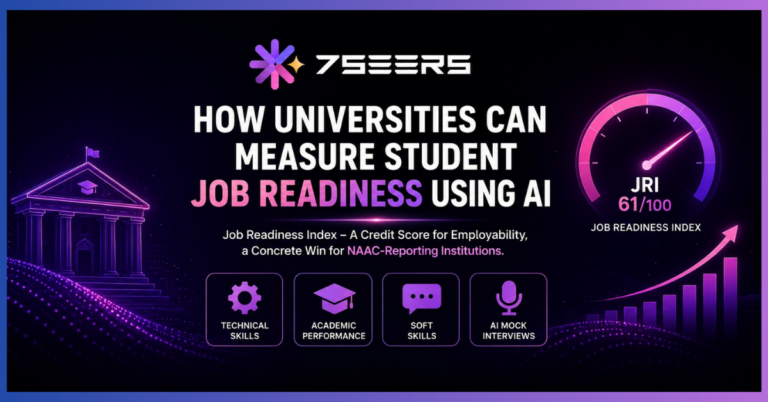
Many institutions are now adopting frameworks such as the Job Readiness Index (JRI) to measure readiness before placement season.
Rather than evaluating students on a single factor, a readiness score provides a comprehensive picture of employability by assessing areas such as:
- Communication skills
- Critical thinking
- Problem-solving ability
- Professional behaviour
- Workplace readiness
- Confidence and career awareness
Think of it as a health check-up for employability.
Instead of discovering weaknesses when a recruiter points them out, colleges can identify and address them much earlier.
Why It Matters
Without a readiness benchmark, placement efforts often become generic.
With a readiness score, placement teams can:
- Identify high-potential students
- Design targeted interventions
- Personalize training programs
- Monitor readiness across departments
Most importantly, they can move from guessing who is ready to actually knowing.
2. Placement Conversion Rate: The Metric That Reveals the Real Story
Many institutions proudly share the number of students who participated in placement drives.
But participation doesn’t equal success.
A more meaningful metric is Placement Conversion Rate—the percentage of students who successfully convert interviews into offers.
Formula
Placement Conversion Rate = Offers Received ÷ Students Interviewed × 100
Let’s say:
- 400 students appeared for interviews
- 120 students received offers
The conversion rate would be 30%.
Now imagine another institution where only 250 students attended interviews but 125 secured offers.
Their conversion rate is 50%.
Which placement strategy appears more effective?
Exactly.
Why It Matters
Conversion rates reveal hidden insights about:
- Interview preparedness
- Employer expectations
- Candidate quality
- Training effectiveness
When tracked consistently, this metric helps TPOs identify patterns and improve future outcomes.
3. Internship Readiness: Because Careers Often Start Before Graduation
The traditional pathway from college to job is changing.
Today, internships have become one of the strongest gateways to employment.
Many organizations use internships as extended evaluation periods before offering full-time roles.
In fact, students who perform well during internships often receive Pre-Placement Offers (PPOs), giving them a significant advantage before placement season even begins.
The challenge?
Many students treat internships casually, while employers view them as auditions for future roles.
What Should Be Measured?
Internship readiness can include:
- Professional communication
- Workplace etiquette
- Team collaboration
- Time management
- Accountability
- Digital and technical proficiency
Why It Matters
A student who is internship-ready is often closer to being job-ready.
Tracking this metric helps institutions prepare students not just for interviews but for actual workplace success.
4. Skill Gap Analysis: Finding Problems Before Recruiters Do
Every recruiter looks for a combination of technical and professional skills.
The problem is that colleges often discover skill gaps only after students start getting rejected.
By then, valuable opportunities may already be lost.
Skill Gap Analysis helps placement teams compare student capabilities against industry expectations.
For example:
A software company may expect:
- Problem-solving ability
- Coding proficiency
- Communication skills
- Teamwork
A student may possess strong coding skills but struggle during collaborative discussions.
Without visibility into these gaps, training efforts can miss the mark.
Why It Matters
Skill gap data enables institutions to:
- Design focused training programs
- Allocate resources effectively
- Improve employability outcomes
- Prepare students for specific industries
Instead of offering ten generic workshops, colleges can deliver three targeted interventions that address actual needs.
5. Placement Readiness Progress Rate: Is Training Actually Working?
Institutions invest significant time and resources into training programs.
Aptitude sessions.
Soft skills workshops.
Interview preparation bootcamps.
Industry certifications.
But here’s the question:
How do you know if they’re making a difference?
This is where Placement Readiness Progress Rate becomes important.
Rather than measuring participation, it measures improvement.
For example:
- Initial readiness score: 55%
- Post-training readiness score: 72%
This indicates meaningful growth.
Why It Matters
Tracking progress allows TPOs to:
- Measure training effectiveness
- Identify high-impact programs
- Improve future interventions
- Demonstrate outcomes to leadership
Data-backed improvement is far more valuable than attendance records.
6. Employer Engagement & Repeat Recruiter Rate
One of the strongest indicators of placement quality isn’t student-related at all.
It’s employer behaviour.
When recruiters repeatedly return to a campus, they’re sending a message:
“We found talent worth hiring.”
Repeat Recruiter Rate measures how many employers choose to return year after year.
Why It Matters
Returning recruiters often indicate:
- Positive hiring experiences
- Strong student quality
- Effective placement support
- Institutional credibility
Building employer relationships is expensive and time-consuming.
Retaining those relationships is significantly more valuable.
For TPOs, this metric provides direct feedback from the market itself.
7. Placement Outcome Quality: Looking Beyond Placement Percentage
Placement percentage is important.
But it doesn’t tell the complete story.
Consider these two scenarios:
Institution A
- 95% placement rate
- Majority of roles unrelated to student specialization
- Limited growth opportunities
Institution B
- 82% placement rate
- Higher-quality roles
- Better compensation
- Strong career progression opportunities
Which institution is delivering stronger long-term outcomes?
Most would choose Institution B.
That’s why placement teams should also track:
- Average salary package
- Median salary package
- Role relevance
- Industry alignment
- Career progression potential
- PPO conversion rates
Why It Matters
Students aren’t just looking for jobs.
They’re looking for careers.
Tracking quality helps institutions align placements with long-term student success.
The Shift Every Placement Team Needs to Make
Traditionally, placement teams have focused on outcome metrics:
- Number of companies visited
- Number of offers received
- Placement percentage
While these remain important, they are lagging indicators.
They tell you what happened.
The seven metrics discussed above are leading indicators.
They help you understand what is likely to happen.
And that’s where real value lies.
Because if you know which students are struggling, which skills are missing, and which interventions are working, you can influence outcomes before placement season begins.
How 7Seers Helps TPOs Move from Tracking to Transformation
The biggest challenge isn’t understanding which metrics matter.
It’s collecting, analysing, and acting on them at scale.
Managing hundreds—or even thousands—of students manually makes this nearly impossible.
This is where 7seers.ai comes in.
7Seers helps institutions gain a deeper understanding of student employability through AI-powered readiness assessments and actionable insights.
With 7Seers, placement teams can:
- Measure Job Readiness at scale
- Identify employability gaps early
- Assess internship preparedness
- Track student progress over time
- Generate institution-level insights
- Create targeted development plans
Instead of relying on assumptions, TPOs gain data-driven visibility into what students need to succeed.
The result is better preparation, stronger employer confidence, and improved placement outcomes..
The Future of Placements Is Data-Driven
The role of the Training & Placement Officer is evolving.
Today, success isn’t just about bringing recruiters to campus. It’s about ensuring students are truly prepared when opportunities arrive.
The institutions leading the way are no longer waiting for placement results to understand student readiness.
They’re measuring it.
Tracking it.
Improving it.
And using it to create better outcomes for every student.
Because in today’s competitive job market, the most valuable placement metric isn’t the number of offers received.
It’s knowing which students are ready to earn them.
Ready to Measure What Matters?
Discover how 7Seers helps colleges and universities assess employability, identify skill gaps, and improve placement outcomes through data-driven insights.
Because the best placement strategies don’t start with interviews—they start with readiness.