You did what everyone told you to do.
You attended classes.
Completed assignments.
Worked on projects.
Prepared for exams.
And now, as graduation approaches, you’re probably asking the same question thousands of students ask every year:
“Am I actually ready for a job?”
It’s a fair question.
Because understanding the skills employers look for in freshers has never been more important — especially as hiring evolves faster than most college curricula.
Because the reality is that getting a degree and being job-ready are no longer the same thing.
Today, recruiters aren’t just looking at your marksheet. They’re looking at your ability to learn, adapt, communicate, solve problems, and work with technology.
In 2026, employability skills for freshers go far beyond academic scores.
In fact, many hiring managers say they can teach someone a tool. What is much harder to teach is mindset.
This creates both a challenge and an opportunity for freshers.
The challenge is obvious: competition is increasing.
The opportunity is that most students still focus only on academics.
This reflects a broader challenge highlighted in our article on graduate employability in India, where academic achievement alone is no longer enough to secure meaningful employment.
Those who build the right skills early often stand out during placements, internships, and interviews.
So what exactly are employers looking for in 2026?
Here are five skills that could make a significant difference in your career journey.
Why Job Readiness Skills for Freshers Matter More Than Ever in 2026
Before diving into the five skills, it’s worth understanding why this conversation is happening now.
The World Economic Forum’s Future of Jobs research consistently highlights that the fastest-growing roles require a combination of technical awareness and deeply human capabilities. For freshers entering campus recruitment and placement season, this means the bar has shifted — and knowing where you stand early can change everything.
1. Adaptability: The Employability Skill That Keeps Freshers Relevant
If there’s one thing that defines today’s workplace, it’s change.
New technologies appear every few months.
Job roles evolve.
Industries transform.
What was relevant two years ago may not be enough today.
For freshers entering the workforce, adaptability has become one of the most sought-after job readiness skills.
As a fresher, this can feel overwhelming.
You spend years learning something, only to hear that AI or automation is changing the way the industry works.
But here’s the good news.
Employers don’t expect freshers to know everything.
They expect them to be willing to learn.
What Does Adaptability Look Like in an Entry-Level Job?
Imagine two graduates joining the same company.
One complains every time a new software tool is introduced.
The other sees it as an opportunity to learn.
A year later, who do you think has grown faster?
Usually, it’s not the person with the highest marks.
It’s the person who adapted.
How You Can Build Adaptability
Learn skills beyond your curriculum.
Explore new technologies even when they aren’t required.
Take online courses regularly.
Be comfortable saying, “I don’t know yet, but I can learn.”
The students who succeed in the coming years won’t be the ones who know everything.
They’ll be the ones who can learn anything.
2. Data Awareness: A Must-Have Skill for Fresh Graduates in Every Field
Data isn’t just for analysts anymore.
Regardless of your field, data literacy is now considered a core workplace skill for fresh graduates.
Whether you’re entering marketing, HR, finance, operations, sales, or even content creation, data influences decisions everywhere.
As a fresher, you don’t need to become a data scientist.
But you should understand how to use information to support your ideas.
Why Data Literacy Matters Even for Non-Technical Freshers
Imagine an interviewer asks:
“What impact did your college project have?”
One student says:
“We created a social media campaign.”
Another says:
“Our campaign increased engagement by 35% over six weeks.”
Who sounds more convincing?
The second student.
Why?
Because they understand outcomes.
Numbers add credibility.
Employers love candidates who can connect actions to results.
How You Can Build Data Awareness
Learn Excel or Google Sheets.
Understand basic metrics relevant to your field.
Use numbers when discussing projects.
Practice reading reports and dashboards.
Data won’t replace creativity.
But it will strengthen your decisions.
3. Technology Fluency: How Freshers Can Build AI Skills for the Modern Workplace
One of the biggest concerns among students today is AI.
Many freshers worry:
“Will AI take my job?”
A better question might be:
“How can AI help me do my job better?”
But technology fluency — the ability to work comfortably with digital tools and AI — is increasingly a baseline expectation in entry-level hiring.
The workplace is becoming increasingly digital.
From project management tools to AI assistants, technology is becoming part of everyday work.
The graduates who understand this will have a major advantage.
Technology Fluency vs. Technical Skills: What’s the Difference?
Two interns receive the same assignment.
One spends five hours manually researching information.
The other uses AI tools to gather insights faster and spends more time improving the quality of the final output.
Who creates more value?
Usually, the second person.
Employers don’t reward effort alone.
They reward outcomes.
How You Can Build Technology Fluency
Learn how AI tools work.
Explore productivity platforms.
Use digital collaboration tools.
Stay curious about emerging technologies.
You don’t need to become a programmer.
You simply need to become comfortable with technology.
4. Communication and Cross-Cultural Collaboration: Why Employers Rank It Among Top Workplace Skills
One misconception many students have is that communication means speaking fluent English.
In reality, communication is much broader.
It’s about expressing ideas clearly.
It’s about listening.
It’s about understanding different perspectives.
And increasingly, it’s about collaborating with people from different cities, countries, and cultures.
Remote Work and Cross-Cultural Teams: A Reality for Today’s Freshers
Imagine you’re working remotely with teammates from Bengaluru, Singapore, and London.
Everyone has different working styles.
Different communication habits.
Different expectations.
Your ability to collaborate effectively becomes just as important as your technical skills.
This is why employers consistently rank communication among the most valuable workplace skills.
How You Can Build It
Participate in group projects actively.
Practice presenting your ideas.
Improve your listening skills.
Learn to give and receive feedback professionally.
The ability to work well with people often creates more opportunities than technical expertise alone.
5. Emotional Intelligence: The Career Readiness Skill Most Students Overlook
When it comes to career readiness skills that students often overlook, emotional intelligence tops the list.
Most students focus on technical skills.
Few focus on emotional skills.
But employers notice them immediately.
Emotional intelligence is your ability to understand emotions, manage stress, and interact effectively with others.
Emotional intelligence (EQ) is the ability to recognize, understand, and manage your own emotions while effectively navigating interpersonal relationships at work.
It influences how you handle criticism.
How you respond to challenges.
How you work in teams.
And how you build professional relationships.
How Emotional Intelligence Affects Your First-Year Performance
Every new employee makes mistakes.
The difference is how they respond.
One employee becomes defensive.
Another accepts feedback, learns, and improves.
Which one would you rather hire again?
The second one.
Every time.
Employers don’t expect perfection.
They expect growth.
How You Can Build Emotional Intelligence
Ask for feedback regularly.
Reflect on your reactions to challenges.
Practice empathy during conversations.
Learn how to manage stress effectively.
As AI becomes better at technical tasks, human skills like empathy, communication, and self-awareness become even more valuable.
You can explore how emotional intelligence at work shapes long-term career success in our related guide.
The Bigger Picture: Campus Placement Preparation Starts With the Right Mindset
Many students think they need the perfect resume before applying for jobs.
The truth is different.
Campus placement preparation isn’t just about your resume — it’s about closing your skill gap before recruiters ask you to.
Most recruiters hiring freshers know you won’t have years of experience.
What they’re looking for is potential.
They’re looking for signs that you can learn quickly.
Adapt to change.
Work well with others.
Use technology effectively.
And continue growing after you’re hired.
That’s why these five skills matter.
Increasingly, these skills are becoming part of how institutions evaluate student outcomes, making job readiness the new metric of institutional success.
They signal that you’re ready for the modern workplace.
Not just your first job.
But the jobs you’ll have five or ten years from now.
So, What Should You Do Next? Start Closing Your Skill Gap Today
Don’t wait until placement season to think about job readiness.
The best time to prepare for campus placements is before opportunities arrive.
Start small.
Learn one new tool.
Take one online course.
Improve one communication skill.
Track one project outcome.
Seek feedback from one mentor.
You can also build a professional resume that reflects these skills with AI-powered guidance.
Small improvements, repeated consistently, create a significant advantage over time.
And remember:
The students who succeed in 2026 won’t necessarily be the smartest.
They’ll be the ones who are the most adaptable, curious, and ready to learn.
Find Out Where You Stand Today
Most students don’t know whether they’re actually job-ready until they sit for placements.
By then, it’s often too late to fix important skill gaps.
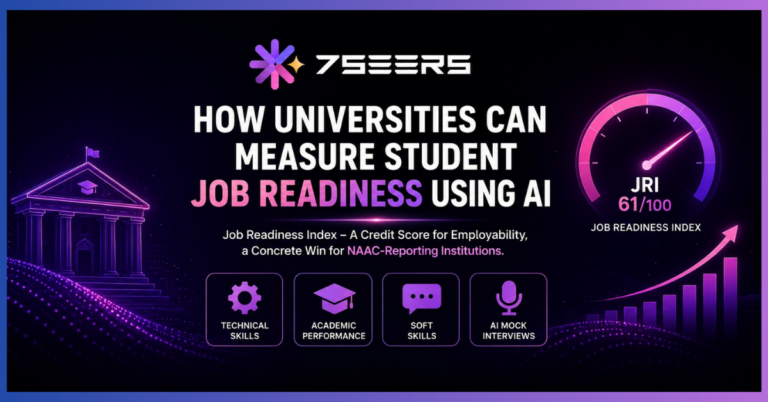
Understanding your current readiness level is critical, which is why many institutions are beginning to adopt frameworks such as the Job Readiness Index (JRI) to measure employability before placement season begins.
That’s why understanding your strengths and improvement areas early matters.
Identifying your skill gaps early is the first step toward becoming truly job-ready as a fresher.
With 7Seers.ai, you can take a job readiness assessment, identify your skill gaps, and gain insights into the capabilities employers are actively looking for in today’s hiring landscape.
Whether you’re preparing for internships, placement preparation, or your first full-time role, knowing where you stand today can help you make better career decisions tomorrow.
Take the Job Readiness Assessment on 7Seers.ai and discover how prepared you are for the opportunities ahead.