Traditional Assessments vs AI Assessments: Which Approach Works Better in Higher Education?
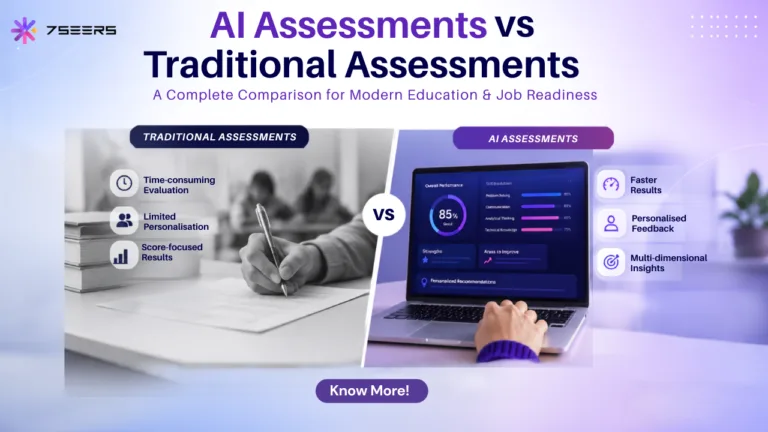
Assessments have always been an important part of education. They help teachers understand whether students have understood a concept, identify areas where they are struggling, and measure their progress over time. For students, assessments provide a way to understand what they know, what they need to improve, and how prepared they are for the next stage of learning. For decades, traditional assessments were the standard approach. Students would sit in classrooms, answer questions on paper and submit their work for teachers or professors to evaluate manually. This method remains widely used because it is familiar, structured and relatively straightforward. However, education is changing. With artificial intelligence entering classrooms, learning platforms and assessment systems, the way students are tested is also evolving. AI can automate parts of the assessment process, provide faster feedback, analyse performance across multiple metrics and create more personalised learning experiences. As AI assessments become increasingly common in higher education, institutions are rethinking how they evaluate student learning, job readiness, and employability alongside traditional assessment methods. This does not mean traditional assessments have become irrelevant. Instead, it raises a more useful question: when should institutions use traditional assessments, and when can AI-powered assessments provide additional value? What Are AI Assessments? AI assessments use artificial intelligence to evaluate student performance, provide personalized feedback, identify skill gaps, and measure competencies beyond traditional exam scores. They help institutions improve learning outcomes, job readiness, and employability through continuous assessment. What Are Traditional Assessments? Traditional assessments are evaluation methods where students are generally assessed through structured tests, assignments, examinations, presentations, or other activities that are designed and evaluated through conventional methods. The most familiar example is the paper-and-pen examination. A teacher prepares the questions, students complete the examination, and the answers are then checked manually. Depending on the assessment, the teacher may award marks, provide comments, or identify areas where the student needs improvement. Traditional assessments have been used for a long time because they provide a structured way to evaluate academic knowledge. They are particularly effective when institutions need to test whether students understand specific concepts or have achieved defined learning outcomes. However, manual evaluation becomes increasingly difficult as student numbers grow. Checking hundreds of answer sheets, maintaining records, and comparing performance across different assessments requires considerable time and effort. Traditional assessment methods also tend to provide a snapshot of performance. A student may know their score after an examination, but understanding why they received that score and what they should work on next may require additional feedback from a teacher. Advantages of Traditional Assessments Traditional assessments continue to have several important advantages. 1. Human Judgement Teachers can consider context while evaluating a student’s work. In essays, presentations and subjective assignments, human judgement can be particularly valuable because the evaluator can understand nuances that a purely automated system may miss. 2. Familiar and Easy to Implement Students, teachers and institutions are already familiar with traditional examinations. Universities have established processes for creating question papers, conducting examinations and maintaining records, making the system relatively easy to understand. 3. Useful for Academic Knowledge Traditional assessments work well when the objective is to measure subject knowledge, theoretical understanding and the ability to apply concepts in a structured academic setting. 4. Direct Interaction Between Educator and Student When teachers evaluate student work, they can identify recurring mistakes and use those observations to guide classroom teaching. This human interaction remains an important part of education. The Rise of AI Assessments in Education Artificial intelligence is changing how many parts of education are delivered, from personalised learning to feedback and evaluation. AI can analyse large amounts of student performance data, identify patterns and generate feedback much faster than manual systems, where AI is also enabling new approaches to adaptive learning, blended learning, active learning and personalised feedback. You can explore these approaches in our guide to Innovative Teaching Methods in the Age of AI This is part of a broader transformation in teaching. AI-enabled approaches can support adaptive learning, blended learning, project-based learning and personalised feedback, allowing educators to use technology not simply to automate existing processes but to create more targeted learning experiences. Assessment is naturally becoming part of this transformation. An AI-powered assessment can evaluate responses, analyse performance across multiple dimensions and provide feedback soon after the assessment is completed. Instead of looking only at the final score, institutions can potentially examine patterns such as accuracy, topic-wise performance, time taken, competency-level performance and improvement over multiple attempts. This creates an important shift: Traditional assessment often asks, “What did the student score?” AI-powered assessment can also ask, “What does this performance tell us about the student’s skills and what should happen next?” Advantages of AI Assessments AI assessments offer several advantages, particularly when institutions are dealing with large student populations or need continuous performance insights. 1. Less Manual Error Manual evaluation can involve inconsistencies, especially when large numbers of responses need to be checked. Automated systems can apply the same predefined evaluation criteria across responses, reducing certain types of human error. That said, AI systems are not automatically error-free. Their accuracy depends on how the system is designed, trained, and validated. Human oversight remains important, especially for subjective or high-stakes assessments. 2. Faster Results One of the biggest advantages is speed. A manually evaluated assessment may take hours or days before students receive their results. AI-powered systems can process many responses much faster, allowing students to identify areas for improvement while the assessment is still fresh in their minds. 3. Better Performance Metrics Traditional assessments often centre around a final score. AI systems can potentially analyse multiple dimensions of performance. For example, an assessment can provide insights into specific competencies, identify weaker areas and compare performance across different attempts. This makes the assessment more useful as a diagnostic tool rather than simply a grading mechanism. 4. Flexibility AI assessments can be delivered digitally, allowing students to complete assessments from different locations and at different times, depending on the institution’s requirements. This flexibility becomes particularly useful for