Most Indian colleges can’t change what they teach. They can still change what their students walk out with.
A final-year student tops his branch with a CGPA of 8.6. In his first technical interview, they ask him to write a simple query joining two tables. He freezes. He studied database management for a full semester and scored well in the university exam. He can define normalization perfectly. He has never written a query against real data.
He did exactly what the system asked. So did his teacher, who completed the syllabus on time with good results. So did the Training and Placement Officer (TPO), who knew the gap existed and had no authority over what was taught.
Nobody failed. The structure did.
Two constraints most colleges can’t escape
India has 48,246 colleges that are constituent, recognized, or affiliated with universities, and 70% are private and unaided. For most, the affiliating university sets the syllabus, exam pattern, and academic calendar. A college can’t add a module on cloud deployment because the industry wants it. A teacher can’t skip a dated unit because recruiters no longer care about it.
The second constraint is harder to talk about: students. They treat university exam marks as the outcome, and they’re not being irrational. Marks decide eligibility for placement drives through CGPA cut-offs, determine higher-study options, and are what parents ask about. Telling students that “exams don’t matter, skills do” contradicts what the system visibly rewards.
So the syllabus is fixed, and the students are, reasonably, exam-focused.
The assumption that broke: If you can’t change the syllabus, you can’t change the outcome.
Add a readiness layer, don’t fight the syllabus
The answer isn’t to fight the curriculum. Add a job-readiness layer on top of it, one that serves exam performance instead of competing with it.
Anchor every mandated unit in a real job. Nearly every topic in the prescribed syllabus maps to skills found in real job descriptions. A database unit maps directly to the SQL tasks in data analyst roles. A software engineering unit maps to testing and version control in developer roles. Teaching the same unit through a job-anchored example changes nothing about syllabus coverage, but changes everything about what students can do afterward.
Make readiness help marks. Students who can apply a concept answer exam questions better than those who memorized it. Practice with question banks that mix university-pattern questions with application questions, tagged to the same syllabus units, and exam-focused students will engage, because it helps them score.
Use the flexibility that already exists. NEP 2020 created space for skill-oriented courses, internships, and credit portability, and many universities now allow value-added or add-on courses alongside the core program. That is where greater job-specific skills can live without touching the mandated syllabus.
Keep two scorecards. Report exam marks as the university requires, and track job readiness separately against real role requirements. When students and parents see both, readiness becomes visible, and it starts to count.
The scale problem
The catch is the same one every Indian college faces. Mapping every syllabus unit to real job requirements, building application examples for each, and tracking each student’s readiness gaps is heavy work for a teacher with 120 students per section and a syllabus to finish. A TPO working with 600 students can’t create individual preparation plans by hand.
AI changes the arithmetic. It can map mandated units against thousands of live job descriptions, generate job-anchored examples and question banks for each unit, identify each student’s specific gaps, and give every student individual practice between classes. Teachers keep class time for the syllabus and for mentoring students on the data flags, and TPOs spend their limited hours with the students who most need a human conversation.
One-on-one support for every student, with mentors where they matter most.
What each stakeholder can do now, and why it’s hard
Teachers
Do now: For each unit you teach this semester, find one real job description that uses that skill, and teach at least one example through it. Add two application questions to every internal test, tagged to the same unit.
Why it’s hard: Finding and adapting job-relevant material for every unit takes time you don’t have, and your performance is measured on syllabus completion and results.
Training and Placement Officers (TPOs)
Do now: Work with faculty to map your top recruiters’ job descriptions to the current semester’s syllabus, and start second-year readiness assessments framed as practice that also helps exam scores.
Why it’s hard: You have no authority over the curriculum, academic and placement teams rarely plan together, and manual mapping across branches and recruiters is overwhelming.
Students
Do now: For every subject, ask one question: which job uses this, and could I actually do that task? Practice application questions alongside exam preparation, since they strengthen both.
Why it’s hard: The exam timetable dominates everything, and nobody shows you how your subjects connect to real roles.
Institution leaders
Do now: Report job readiness alongside results, and use NEP and university provisions for skills courses and internships to create room for the readiness layer.
Why it’s hard: Everyone judges university results, and adding anything to a packed calendar meets understandable resistance.
Industry leaders
Do now: Share your job descriptions and a sample assessment with the colleges you hire from, so they can map their syllabus to what you actually test.
Why it’s hard: Recruiting teams share requirements late and rarely think of academic mapping as their job.
What to look for in a solution
The goal is to deliver job readiness inside a curriculum you can’t change. The right platform should offer:
Syllabus-to-skill mapping: map each mandated unit against live job descriptions so teachers and TPOs can see which skills every topic builds and where the gaps are.
Job-anchored teaching material: AI-assisted lesson plans, presentations, and examples that teach the prescribed topic through real job contexts, without changing syllabus coverage.
Question banks that serve both goals: university-pattern and application questions tagged to the same units and to Bloom’s taxonomy levels, so exam preparation and readiness reinforce each other.
Personal readiness paths: skill-gap analysis and learning paths for each student against their target role, running alongside the syllabus.
Practice between classes: a Socratic AI tutor and AI mock interviews that give every student individual practice without adding to class time.
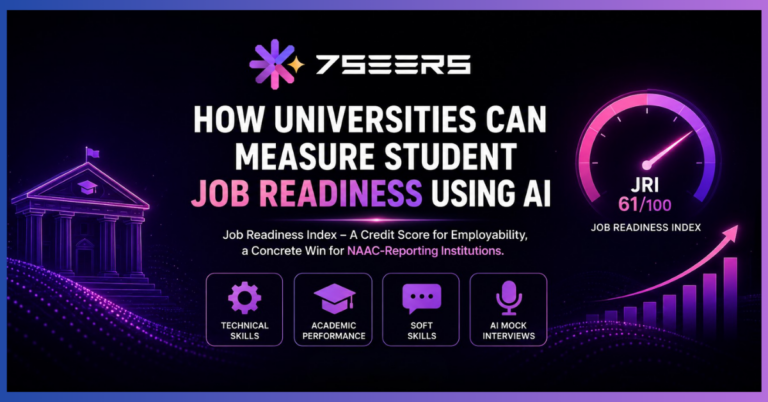
Two scorecards: a job readiness index tracked alongside academic results, visible to students, teachers, TPOs, and parents.
Content for add-on and skill courses: ready-to-use, job-aligned material for value-added and skill-oriented courses the institution can offer within university and NEP provisions.
In short, look for an employability operating system that works inside your mandated syllabus rather than asking you to change it.
The bottom line: You can’t change the syllabus, and your students will keep caring about marks. You can still anchor every unit in a real job, make readiness help exam performance, and measure what students can actually do. The syllabus is fixed. The outcomes aren’t.
Teachers and TPOs: Which unit in your syllabus would benefit most from a real job example?
See how a connected learning-to-employment ecosystem works → http://7seers.ai
Previous in this series: Accreditation Rewards the Change Colleges Fear.
Next in this series: Teaching Industry Skills You’ve Never Used At Work.