Every year, thousands of students walk across your stage, degree in hand. The question no one asks aloud — but every TPO and vice chancellor quietly dreads — is: how many of them are actually ready to be hired?
Not ready as in “they struggled in their final semester. ” Ready as in: can they walk into a technical interview for a data analyst role at a mid-sized company, understand what the job description is asking for, demonstrate the relevant skills, and hold their own against candidates from other colleges?
For most institutions in India, the honest answer is: we don’t know. And that uncertainty — that absence of visibility — is exactly where the graduate employability in India crisis lives.
In fact, many institutions are beginning to question this more directly, as explored in is your campus really job-ready?’
Platforms like 7Seers are emerging to solve exactly this visibility gap by giving institutions real-time insight into student readiness.
The number that should be on every VC’s wall
Only around 50% of Indian graduates are considered employable by industry, according to NASSCOM and AICTE data. That means for every two students your institution graduates, one is statistically unlikely to secure meaningful employment in their field of study within a reasonable timeframe.
Read that again. Not because it’s new — most leaders in higher education have heard some version of this statistic. But because we have largely treated it as an industry problem, or a student attitude problem, or an economic cycle problem.
It is none of those things. It is a system design problem. And system design problems can be fixed.
The gap between education and employment is already being addressed through structured platforms, as seen in how institutions are bridging the gap between students and industry-ready careers.
Stop blaming the student. Look at the system
Here is what students are actually doing to prepare for placement — drawn from a primary research study of 173 students conducted with IIM Nagpur in March 2026:
- 55% of students Google each JD skill individually. No structured tool exists in their journey.
- 54% address skill gaps by self-studying using random internet resources. Only 14% attend institutional workshops consistently.
- 45% prepare for interviews using random YouTube videos. Another 45% rely on what seniors told them about interviews they sat years ago.
- 42% build their resume from a Canva template — visually formatted, strategically empty, with no alignment to specific job descriptions.
- 40% say lack of guidance and mentorship is their single biggest career challenge. Not lack of time. Not a lack of resources. Guidance.
These are not lazy students. They are students who have been left largely to figure out their career preparation on their own, using whatever tools they can find. They have normalized the confusion. They don’t know what good looks like, so they assume what they are doing is sufficient.
The institution, meanwhile, is structurally absent from the most critical stage of a student’s journey.
The trap of comfortable mediocrity
Here is the part that makes this problem particularly difficult to solve: most students don’t feel like they’re in crisis.
In the same IIM Nagpur research, the average Job Readiness Index (JRI) score across surveyed students was 67 out of 100. Not failing. Not alarming. Moderate.
Students who score 67 feel reasonably prepared. They’ve done something. They’ve polished a resume, skimmed some interview tips, and maybe practiced a few MCQs. They’re not panicking. And because they’re not panicking, they’re not seeking help.
But the hiring bar has moved. In 2026, the industry expects AI fluency, role-specific preparation, and demonstrable applied skills — not just a degree and a decent CGPA. A student who feels “mostly ready” and a student who is actually hireable are increasingly different people.
The tragedy is that the gap between them is not talent. It is structured.
Students who followed a structured assessment process scored nearly 7.5 JRI points higher than those who didn’t. Students who took a targeted, role-specific approach to their applications scored 9 JRI points higher than those who applied indiscriminately. The data is consistent and clear: structured, personalized preparation works. The students who get it perform better. Most students are simply not getting it.
Three places where the system is failing — not the student
1. The visibility failure
Most institutions have no real-time view of which students are job-ready, which roles they’re targeting, or what specific skills they’re missing. TPOs manage placement drives reactively — coordinating company visits, scheduling drives, chasing confirmations — while the actual readiness of the student body remains invisible until the results come in.
By then, it’s too late to intervene.
Placement outcomes are measured after the fact, rather than managed beforehand. The entire model is reactive. It’s like discovering a water leak only when the ceiling collapses.
2. The feedback loop failure
Companies that recruit from Indian campuses will privately tell you they budget for fresher retraining. They expect to spend the first few months bringing new hires up to a functional standard. This cost is so normalised it no longer shocks anyone.
But that normalization is damaging. It means companies are quietly lowering their expectations of campus hires. It means they visit fewer campuses over time, focusing on the handful where graduates tend to arrive genuinely prepared. And it means the feedback — “your students aren’t ready for what we actually need” — almost never reaches academic departments in time to influence the next cohort’s curriculum.
The pipeline is broken at the source. And no one is measuring where exactly.
3. The guidance failure
40% of students say lack of guidance is their number one career challenge. That is a direct indictment of institutional support — and it’s not a condemnation. It is a structural reality.
A TPO managing 400 to 800 students cannot personally mentor each one through a personalized career path. It is simply not possible at the human scale. The guidance gap is not a failure of effort or intention. It is a failure of infrastructure.
Students who don’t receive structured guidance default to seniors, YouTube, and random internet searches. They piece together a preparation strategy from fragments. Some get lucky. Most don’t.
What actually works — and what that means for your institution
The research is encouraging on this front. The interventions that close the employability gap are not expensive or exotic. They don’t require you to rebuild your curriculum from scratch. They require giving students structure, personalization, and role-specific feedback — consistently, at scale.
Learning path completion is the single strongest predictor of overall employability readiness, with a correlation of 0.814 with JRI in the study data. When students have a clear, personalized roadmap tied to a specific role or job description, readiness follows. The correlation is not subtle — it is the dominant variable.
This points to an important point: students don’t need more content. They need a path through the existing content, mapped to where they are and where they want to go.
The institutional stakes
It is easy to treat the employability problem as a student welfare issue. It is actually a strategic institutional issue.
Placement rates feed directly into admission demand. Students and parents in India increasingly choose colleges based on placement outcomes — particularly in the Tier 2 and Tier 3 segment, where word travels fast. A college with strong placements fills seats. A college with declining placements struggles to justify its fees, loses students to other options, and enters a downward cycle that is difficult to reverse.
Placement quality also feeds NAAC and NBA accreditation scoring. Institutions that can demonstrate structured employability programs, measurable outcomes, and employer engagement are better positioned in every accreditation cycle than those that manage placements informally.
The honest starting point (Future of Employability in India)
The most important shift is not technological. It is epistemic. It is moving from “we believe our students are reasonably prepared” to “we know exactly where our students stand, role by role, cohort by cohort, and we have a plan for every gap.”
That shift requires visibility. It requires data. It requires a system that is present throughout the student’s career preparation journey, not just during placement season.
The good news is that the gap between where most institutions are today and where they need to be is not as wide as it might feel. The students are willing to prepare. The structure is what’s missing. When you give students a clear path, they follow it. The research proves this.
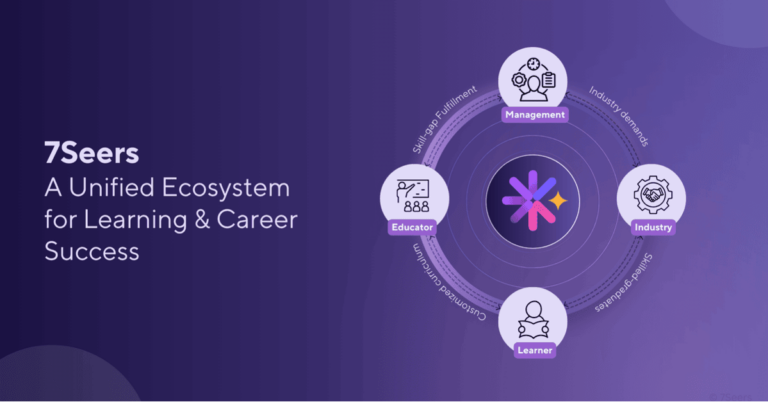
7Seers gives TPOs and institutional leadership real-time visibility into student job readiness — from skill gap analysis and personalized learning paths to AI mock interviews and placement dashboards. If you’re ready to move from reactive placement management to proactive employability infrastructure, we’d like to show you what that looks like for your institution.
Request a demo → https://7seers.ai/
If you’d like to understand how this can work for your institution, feel free to get in touch with our team for a quick walkthrough.