Universities have always relied on reports to make important decisions, like placement reports, accreditation reports, student performance reports, NAAC documentation, and annual employability reports.
But here’s the problem.
By the time most institutions receive these reports, the opportunity to act has already passed. If a student’s communication skills were weak in August, discovering it in the annual placement report next April doesn’t help anyone. If a department had low employability scores throughout the semester, identifying it after campus placements are over won’t improve placement outcomes.
Higher education is changing rapidly. Student expectations are changing. Recruiter expectations are changing. Technology is changing. The way institutions make decisions has to change too. The future doesn’t belong to institutions that simply collect data. It belongs to institutions that can act on data in real time.
The Problem with Annual Reports
Annual reports have always served an important purpose. They help institutions understand what happened over the past year; they support accreditation; they provide management with performance summaries; they assist in compliance. But annual reports answer only one question:
“What happened?”
What university leadership really needs is answers to questions like:
- Which students are at risk of not getting placed?
- Which departments need immediate intervention?
- Which skills are consistently missing across batches?
- Which students require additional mentoring?
- Which recruiters may struggle to find suitable candidates?
Waiting until the end of the academic year to discover these answers is no longer practical.
Universities Don’t Have a Data Problem. They Have a Visibility Problem.
Most universities already collect enormous amounts of student data.
Attendance, internal assessments, semester marks, assignment scores, placement registrations, resume submissions, workshop participation, certification records.
The challenge isn’t the lack of information. The challenge is that this information exists in different systems and rarely translates into meaningful insights. Leadership teams often receive hundreds of pages of reports without getting clear answers to simple questions like:
Are our students actually becoming industry-ready?
Why Real-Time Student Intelligence Matters
Imagine if university leadership could see:
- Students who need interview practice before placement season
- Departments with declining employability scores
- Communication skill gaps across an entire batch
- Students who haven’t completed assessments
- Placement readiness trends across multiple campuses
Instead of reacting after placements, institutions could intervene while there is still time. This shift changes the role of leadership. Instead of reviewing history, they begin shaping outcomes.
The Cost of Delayed Decisions
Small problems become large problems when they go unnoticed. Consider a student preparing for placements. Without regular feedback, they may continue making the same mistakes in interviews for months. A department may believe students are industry-ready simply because academic performance is good.
Recruiters may reject candidates due to poor communication, lack of confidence, or weak problem-solving skills areas traditional academic reports rarely measure. When these gaps are identified only after campus hiring, institutions lose valuable opportunities to improve outcomes.
AI Is Changing How Universities Measure Student Readiness
Artificial Intelligence is no longer limited to automating administrative tasks. It is helping universities understand student preparedness continuously. Instead of waiting for annual reports, AI can provide ongoing insights into:
- Interview performance
- Communication skills
- Technical readiness
- Assessment performance
- Confidence levels
- Learning progress
This enables educators to support students throughout their journey rather than only during placement season. In fact, AI is also helping institutions identify placement risks months before recruiter visits. If you’re interested in learning how predictive analytics is transforming placement preparation, read our blog:
How AI Helps TPOs Predict Placement Risks Before Campus Hiring Begins
Student Intelligence Is More Than Academic Performance
A student with excellent grades may still struggle in interviews. Similarly, an average academic performer may become an outstanding employee because of strong communication, adaptability, and problem-solving abilities.
Employers increasingly evaluate:
- Communication
- Critical thinking
- Collaboration
- Adaptability
- Emotional intelligence
- Practical problem-solving
These indicators rarely appear in conventional academic reports. Real-time student intelligence bridges this gap. It gives institutions a broader understanding of student development beyond classroom performance.
Leadership Needs Dashboards, Not Documents
Modern university leadership doesn’t have time to review lengthy reports every month. What they need are clear, actionable dashboards that answer questions instantly.
Imagine opening a dashboard and immediately knowing:
- Overall placement readiness across the institution
- Departments requiring intervention
- Students needing additional mentoring
- Mock interview completion rates
- Skill gaps across different domains
- Internship participation
- Employability trends over time
Instead of spending weeks preparing reports, leadership can focus on improving student outcomes.
Better Visibility Creates Better Student Outcomes
Real-time intelligence benefits everyone.
University Leadership
- Better decision-making
- Improved resource allocation
- Stronger placement planning
TPOs
- Early identification of at-risk students
- Better recruiter preparation
- Data-backed placement strategies
Faculty
- Clear understanding of student skill gaps
- Personalized interventions
Students
- Continuous improvement
- Personalized feedback
- Higher confidence before interviews
Everyone works from the same source of truth.
Measuring Employability Is Becoming a Competitive Advantage
Students today don’t choose universities based only on infrastructure or rankings.
Increasingly, they ask:
- What are the placement outcomes?
- How does the university prepare students?
- Will I become industry-ready?
Universities that continuously measure employability can answer these questions with confidence.
If you’re exploring how AI can help institutions measure employability more effectively, we recommend reading:
Student Job Readiness in India: How Universities Can Measure Employability Using AI
From Reactive Leadership to Predictive Leadership
Traditional reporting tells leadership what happened. Real-time intelligence tells leadership what needs attention today. Predictive intelligence tells leadership what may happen tomorrow.
That shift changes everything.
Instead of responding to placement challenges, universities begin preventing them. Instead of discovering skill gaps after recruiter feedback, they identify them months earlier. Instead of measuring success once a year, they improve it every day.
How 7Seers Helps Universities Make Better Decisions
At 7Seers, we believe institutions shouldn’t have to wait for annual reports to understand student readiness. Our AI-powered platform provides universities with continuous insights into student employability through:
- AI Mock Interviews
- Industry-ready Assessments
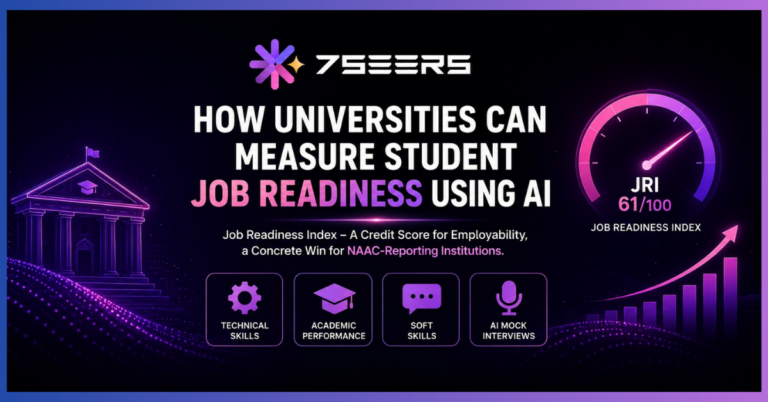
- Job Readiness Index (JRI)
- Skill Gap Analysis
- Placement Readiness Dashboards
This enables leadership teams, TPOs, and faculty members to make informed decisions that improve student outcomes before placement season begins.
Learn more about how we’re helping institutions build industry-ready graduates:
Final Thoughts
Higher education is entering an era where decisions need to happen faster than ever. Annual reports will always remain important for governance and compliance, but they shouldn’t be the primary tool for understanding student readiness. Real-time student intelligence enables institutions to move from measuring performance to improving it.
And when universities act earlier, students graduate with greater confidence, stronger skills, and better career opportunities because the goal isn’t simply to review the past. It’s to shape the future.