Every placement season tells a story.
Some universities celebrate record-breaking placements. Others spend months wondering why eligible students weren’t shortlisted, why recruiters weren’t satisfied, or why placement numbers declined despite extensive training.
The reality is simple:
Most placement challenges don’t begin during recruitment season. They begin months earlier.
By the time interview invitations are sent, resumes are reviewed, and aptitude tests begin, many students have already fallen behind. Unfortunately, traditional placement tracking methods—Excel sheets, attendance records, mock test scores, and manual reports—often reveal these issues only when it’s too late to intervene.
Artificial Intelligence is changing this approach.
Today, AI in campus placements is helping universities identify placement risks early, improve student employability, and enable Training and Placement Officers (TPOs) to make proactive, data-driven decisions before recruitment season begins.
Instead of reacting to placement failures, universities can now predict them. AI helps Training and Placement Officers (TPOs) identify at-risk students months in advance, allowing institutions to take proactive action that improves employability outcomes.
The Problem with Traditional Placement Tracking
What Is AI in Campus Placements?
AI in campus placements uses student data, skill assessments, engagement analytics, and job readiness indicators to identify placement risks early, helping institutions improve employability and placement outcomes before recruitment begins.
Most placement cells measure progress using lagging indicators such as:
- Number of students placed
- Placement percentage
- Number of recruiters visiting campus
- Interview attendance
- Final offer letters
While these metrics are important, they only describe what has already happened.
They don’t answer critical questions like:
- Which students are likely to struggle during placements?
- Which departments are falling behind?
- Which skills are missing across the batch?
- Are students actually improving after training?
- Which interventions are working—and which aren’t?
Without these insights, placement teams often rely on assumptions rather than data.
Why Placement Risks Need Early Detection
Think of placement readiness like healthcare.
Doctors don’t wait until a patient becomes critically ill before recommending treatment. They monitor health indicators to detect risks early.
Placement should work the same way.
Students don’t suddenly become “unemployable” during campus interviews. Warning signs appear months beforehand:
- Low participation in placement activities
- Weak technical assessment scores
- Poor communication skills
- Resume quality issues
- Inconsistent learning progress
- Skill gaps for target job roles
- Lack of interview practice
AI continuously tracks these signals and identifies patterns long before placement season begins.
How AI Predicts Placement Risks
Modern AI platforms combine multiple data points to build a complete picture of student readiness rather than relying on a single exam score.
Instead of evaluating only academic performance, AI analyses factors such as:
1. Skill Gap Analysis
AI compares each student’s current skills with the requirements of specific job roles.
Rather than telling students they’re “not ready,” it identifies exactly what’s missing.
For example:
- Java Developer → Needs stronger Data Structures and Spring Boot
- Data Analyst → Needs SQL and Power BI
- Cloud Engineer → Needs AWS certification fundamentals
This enables TPOs to identify risk clusters across entire departments. 7Seers performs this comparison by mapping student skills directly against job requirements, making readiness visible before applications begin.
2. Continuous Job Readiness Measurement
Traditional assessments provide one score.
AI continuously measures improvement over time.
Instead of asking:
“Did the student pass?”
AI asks:
- Is the student improving?
- How quickly are they learning?
- Are interventions working?
- Is readiness increasing month over month?
Platforms like 7Seers use a standardized Job Readiness Index (JRI) that combines technical assessments, AI mock interviews, soft skills, and academic performance into a single employability score, helping universities benchmark students against industry expectations.
3. Behaviour & Engagement Analytics
Students who disengage from placement preparation often become placement risks.
AI can monitor:
- Assessment participation
- Attendance
- Course completion
- Learning activity
- Practice interview frequency
When engagement drops, placement teams receive early visibility instead of discovering problems during recruitment season.
7Seers includes student engagement and attendance intelligence that helps TPOs identify low-engagement students early and improve participation across placement readiness programs.
4. Resume Intelligence
Many students never reach interviews because their resumes fail Applicant Tracking Systems (ATS).
AI evaluates:
- Resume structure
- Missing keywords
- Content quality
- Job-description alignment
Students receive actionable suggestions long before recruiters review their profiles.
This significantly improves shortlist rates during campus recruitment.
5. AI Mock Interview Performance
Communication often becomes the deciding factor in placements.
AI-powered mock interviews simulate real interview experiences while evaluating:
- Confidence
- Technical knowledge
- Communication clarity
- Response quality
- Improvement over time
Rather than waiting for recruiter feedback, TPOs can identify students needing interview coaching months in advance.
From Reactive Placement Management to Predictive Placement Intelligence
Traditional placement management follows a reactive cycle:
Training → Interviews → Results → Analysis
AI changes the sequence:
Assessment → Prediction → Intervention → Improvement → Placement
This shift gives placement officers time to act before recruitment begins.
Instead of asking:
“Why wasn’t this student selected?”
TPOs can ask:
“What support does this student need today to succeed three months from now?”
Benefits for TPOs
AI doesn’t replace placement officers—it empowers them with better insights and faster decision-making.
Key advantages include:
Early Risk Identification
AI flags students who are likely to face placement challenges well before campus hiring starts, allowing timely interventions.
Department-Level Insights
Rather than reviewing hundreds of individual reports, TPOs can identify which departments, courses, or batches need additional training.
Personalized Learning Paths
Instead of assigning the same training to everyone, AI recommends targeted learning journeys based on each student’s specific skill gaps. 7Seers enables TPOs to orchestrate structured placement readiness programs by sequencing assessments, content, and mock interviews into outcome-driven learning paths.
Better Recruiter Satisfaction
Recruiters receive better-prepared candidates, improving selection rates and strengthening long-term campus relationships.
Data-Driven Placement Strategy
Placement planning becomes evidence-based rather than assumption-based.
This becomes even more effective when institutions consistently monitor key training and placement metrics across departments.
TPOs can prioritize resources where they’ll have the greatest impact.
Building a Predictive Placement Ecosystem
AI works best when readiness is measured continuously rather than only during final-year placements.
An effective placement intelligence system typically includes:
- Regular skill assessments
- Job-role mapping
- AI-powered resume analysis
- Mock interviews
- Learning progress tracking
- Student engagement analytics
- Placement dashboards
- Readiness benchmarking
Together, these components create an early warning system that helps institutions intervene before students fall behind.
The Future of Campus Placements Is Predictive
Higher education is moving beyond placement percentages.
Forward-thinking universities are beginning to measure something far more valuable:
Placement readiness.
Institutions that continuously monitor employability throughout the academic journey can:
- Reduce placement risks
- Improve recruiter confidence
- Increase student success
- Make smarter training investments
- Strengthen accreditation outcomes
- Enhance institutional reputation
The goal is no longer to count placements after they happen.
The goal is to predict placement success before recruitment even begins.
How 7Seers Helps TPOs Stay Ahead
7Seers is an AI-powered education-to-employment platform designed to help universities move from reactive placement management to predictive employability intelligence.
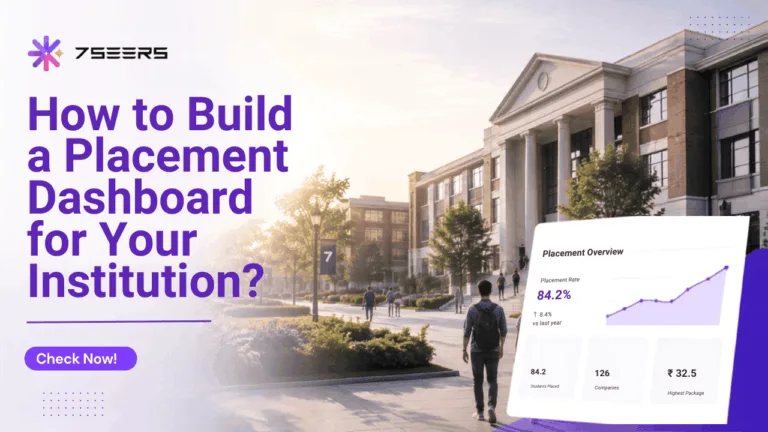
Instead of relying on fragmented spreadsheets and manual tracking, 7Seers gives TPOs a centralized placement dashboard with real-time visibility into student readiness, applications, skills, and placement progress. It combines AI-driven skill gap analysis, personalized learning paths, JD-based assessments, AI mock interviews, student engagement analytics, department-wise insights, and the proprietary Job Readiness Index (JRI) to identify placement risks early and guide targeted interventions.
By helping institutions identify at-risk students months before recruitment begins, 7Seers enables placement teams to focus on improving outcomes—not just reporting them.