Blogs

Student Job Readiness in India: How Universities Can Measure Employability Using AI

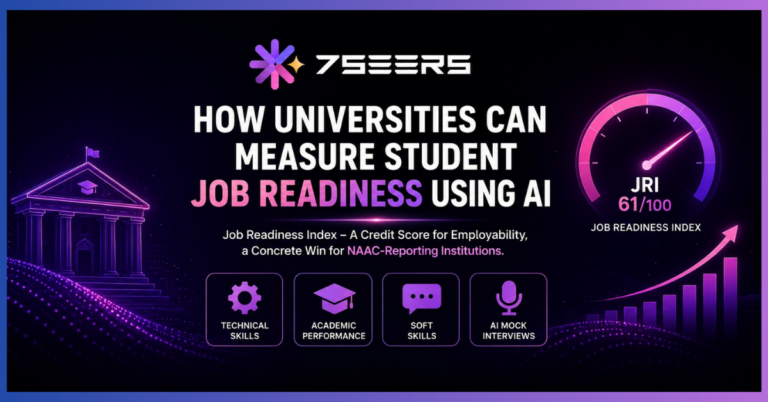
Introducing the Job Readiness Index (JRI) — a data-driven way to measure student employability and improve placement outcomes. Every year, thousands of students graduate with strong GPAs and weak job prospects. The problem isn’t intelligence or effort — it’s that universities have never had a reliable way to measure, in real time, whether a student is actually ready to walk into a job interview and succeed. Until now. Platforms like 7Seers are helping institutions move from guesswork to real-time visibility into student job readiness — solving one of the biggest gaps in higher education today. What is Student Job Readiness (and Why It Matters for Universities)? Placement success is no longer about degrees — it’s about job readiness. Universities today face a critical challenge: That gap is where the employability crisis exists. This is exactly what the Job Readiness Index (JRI) is designed to solve. What is the Job Readiness Index (JRI)? Think of it like a credit score — but for employability. A single, AI-driven score that continuously measures how job-ready a student is — updating in real time as they learn, practice, and improve. Unlike traditional placement metrics, JRI is: It evolves as students: The Four Pillars of Student Employability Measurement The Job Readiness Index evaluates students across four critical dimensions: Technical Skills Domain knowledge, JD-based assessments, role-specific competencies Academic Performance CGPA and course completion as a baseline Soft Skills Communication, teamwork, professional behavior AI Mock Interviews Real-time interview performance — often the biggest gap In a real cohort, JRI improved from 42 to 61+ after structured intervention — proving that guided preparation significantly improves job readiness. Why Measuring Student Job Readiness is Critical for Universities 1. From Reactive Placements to Proactive Strategy Traditional placement systems are reactive. With JRI, institutions can: 2. Real-Time Visibility for TPOs and Leadership Institutions can segment students into: This transforms placement from guesswork into data-backed decision making. 3. Department-Level Insights (Not Just Averages) Unlike traditional systems, JRI provides: This enables targeted interventions instead of generic training programs. AI in Education: The Shift from Teaching to Measurable Outcomes Higher education is no longer just about delivering content — it’s about outcomes. This shift is already visible across institutions, as explored in the future of higher education in the age of AI AI is enabling: And most importantly, measurable employability. JRI and NAAC/NIRF: Turning Data into Accreditation Advantage This is where JRI becomes a strategic asset. NAAC and NIRF require: JRI provides: No spreadsheets. No guesswork. Just ready-to-submit data. Why Job Readiness is the New Institutional KPI Graduation rates are no longer enough. Institutions are increasingly evaluated on: As discussed inwhy job readiness is the new metric of institutional success Job readiness is becoming the core metric of institutional success. The Shift Universities Need to Make The question is no longer:“Are students studying?” The real question is:“Are students job-ready?” JRI creates a shared language for: It turns employability from a post-result metric into a real-time system. Ready to Measure Your Students’ Job Readiness? Run a free Job Readiness assessment drive for your current batch and get: If you’d like to understand how this can work for your institution,get in touch with our team Request a demo