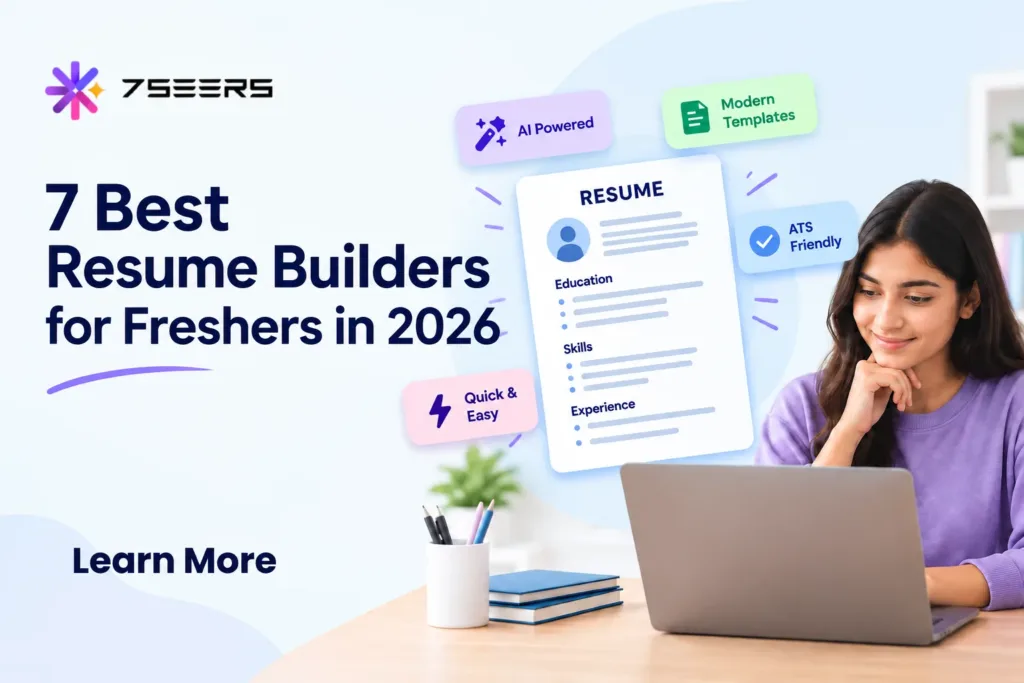
7 Best Resume Builders for Freshers in 2026
For a fresher, creating a first resume can feel harder than it should. You have spent years studying, completed projects, attended workshops, earned certifications, participated in college activities, and perhaps completed an internship. But when you open a blank document, one question appears: “What exactly should I put on my resume?” This is where resume builders can help. A good resume builder can help you structure your information, choose an appropriate format, improve your content, and create a professional resume. But in 2026, resume building is going beyond templates. Students are increasingly looking for tools that can help with AI-generated content, ATS optimization, job-description matching, resume feedback, and broader career preparation. Current Indian resume-builder comparisons also show strong interest in ATS compatibility and fresher-specific requirements. So, here are 7 resume builders worth considering. 1. 7Seers ATS Resume Builder 7Seers takes a broader approach to resume building. Instead of treating a resume as a standalone document, it connects resume preparation with the larger question of job readiness. Students can work on their resume while also preparing through: This is particularly relevant for college students preparing for internships and campus placements. Best for: Students who want resume building combined with career preparation. 1. Resume.io Resume.io provides structured templates and guided resume creation. It’s useful for students who don’t know where to begin and want a guided process. Best for: First-time resume creators. 2. Enhancv Enhancv focuses on helping candidates communicate their professional story through resume design and content. It’s useful for students who have projects, achievements, leadership experiences, or other material they want to present more effectively. Best for: Story-driven resumes. 3. 7Seers Resume Builder 7Seers takes a broader approach to resume building. Instead of treating a resume as a standalone document, it connects resume preparation with the larger question of job readiness. Students can work on their resume while also preparing through: This is particularly relevant for college students preparing for internships and campus placements. Best for: Students who want resume building combined with career preparation. 4. Kickresume Kickresume combines resume templates with AI-assisted writing. Students can use it to improve descriptions of their experiences and create different versions of their resume. Best for: Students who need help writing resume content. 5. Teal Teal goes beyond basic resume creation by connecting resume building with job-search organization. This can be useful for students applying to multiple roles. Instead of having one generic resume, students can work toward tailoring their applications to different job descriptions. Best for: Students managing multiple applications. 6. Zety Zety provides guided resume creation and templates. The step-by-step approach can be particularly helpful for students creating their first professional resume. Best for: Beginners. 7. Indeed Resume Indeed provides resume functionality as part of its broader job-search ecosystem. For students already searching for jobs through Indeed, maintaining a resume there can be convenient. Best for: Students actively using Indeed for job hunting. Which Resume Builder Is Best for Freshers? There isn’t one universal winner. The right choice depends on what you’re trying to solve. Your Need Tool to Consider Resume + job readiness 7Seers Professional templates Resume.io Resume storytelling Enhancv AI-assisted writing Kickresume Job application management Teal But here’s the part many students miss. The tool is not the most important part of your resume. The content is. What Should Freshers Put on Their Resume? 1. Projects Projects can be extremely valuable for freshers because they demonstrate what you can actually build or accomplish. Don’t write: “Made a website.” Write: “Built a responsive e-commerce website using React with product filtering, authentication, and payment integration.” The second version provides evidence of capability. 2. Internships Don’t simply list the company and job title. Explain your contribution. For example: Weak: “Marketing Intern – ABC Company” Stronger: “Created and managed social media campaigns that generated 20,000+ impressions over four weeks.” Whenever possible, quantify your contribution. 3. Certifications Certifications can demonstrate initiative, particularly when they are relevant to the position. If you’re applying for a data role, relevant certifications in analytics, SQL, Python, or visualization may be more useful than an unrelated certificate. 4. Technical Skills Keep your skills relevant. If you’re applying for a software role, list technologies you can actually work with. And remember: Never list a skill just because you saw it in the job description. If it’s on your resume, be prepared to discuss it in an interview. 5. Achievements Consider including: The goal is to demonstrate initiative, problem-solving, leadership, or other relevant qualities. What Is an ATS-Friendly Resume? ATS stands for Applicant Tracking System. Many companies use software to process and organize job applications. This means your resume should not only look good to a human—it should also be structured in a way that is easy for recruitment systems to process. Generally, students should prioritize: Avoid turning your resume into a graphic poster when you’re applying to roles that rely heavily on ATS screening. The objective is: Readable for the system. Readable for the recruiter. Should Freshers Use AI to Build Their Resume? Absolutely—but carefully. AI can help you: But AI should never invent information. Don’t let an AI tool create: Your resume should be AI-assisted, not AI-generated fiction. Resume vs Job Readiness Here’s perhaps the most important point for freshers. A resume can help you get shortlisted. It cannot guarantee that you’ll clear the interview. Consider this: Your resume says: Python The interviewer asks: “Write a Python function to solve this problem.” Your resume says: Leadership The interviewer asks: “Tell me about a time you handled conflict within your team.” Your resume says: Communication The interviewer asks: “Explain your final-year project in two minutes.” Now your actual capability matters. That’s why resume building should be only one part of your placement preparation. A Better Career Preparation Process Instead of thinking: Resume → Apply → Wait Try: Step 1: Identify the role What job are you targeting? Step 2: Understand the skills What does the employer actually require? Step 3: Identify your gaps Which skills do you have? Which ones